
When a service member is being relocated for a timespan of longer than 20 weeks, this is considered a permanent change of station or PCS. These moves happen all the time and military service members are called upon to relocate to new assignments as frequently as once every couple of years.
If you or a member of your staff are going through a PCS, it’s important to understand your PCS weight allowance to make sure you stay compliant so you don’t have to pay any extra money out of pocket. Exceeding your authorized weight can leave you responsible for the excess transportation cost, so it pays to know your number before you start packing.
Your PCS household goods (HHG) weight allowance is primarily determined by your pay grade and whether you have dependents on the effective date of your PCS orders. Your move type and destination can also affect what you’re authorized to ship.
Use the chart below to find your standard PCS weight allowance, then learn what counts toward it, which items receive special treatment, and how to avoid going overweight.
PCS Weight Allowance by Pay Grade
The standard PCS household goods allowances below are based on the Joint Travel Regulations (JTR), the official source for military travel and transportation entitlements.
| Grade | Without Dependents | With Dependents |
| O-10 through O-6 | 18,000 lbs. | 18,000 lbs. |
| O-5 / W-5 | 16,000 lbs. | 17,500 lbs. |
| O-4 / W-4 | 14,000 lbs. | 17,000 lbs. |
| O-3 / W-3 | 13,000 lbs. | 14,500 lbs. |
| O-2 / W-2 | 12,500 lbs. | 13,500 lbs. |
| O-1 / W-1 / Service Academy Graduates | 10,000 lbs. | 12,000 lbs. |
| E-9 | 13,000 lbs. | 15,000 lbs. |
| E-8 | 12,000 lbs. | 14,000 lbs. |
| E-7 | 11,000 lbs. | 13,000 lbs. |
| E-6 | 8,000 lbs. | 11,000 lbs. |
| E-5 | 7,000 lbs. | 9,000 lbs. |
| E-4 | 7,000 lbs. | 8,000 lbs. |
| E-3 and below | 5,000 lbs. | 8,000 lbs. |
| Aviation Cadets | 7,000 lbs. | 8,000 lbs. |
| Service Academy Cadets/Midshipmen | 350-lb. TDY allowance | — |
*Important: Your PCS orders and transportation office determine your actual entitlement. Special allowances or restrictions can apply based on your assignment, duty location and move type.
How Much Does Your Household Goods Shipment Weigh?
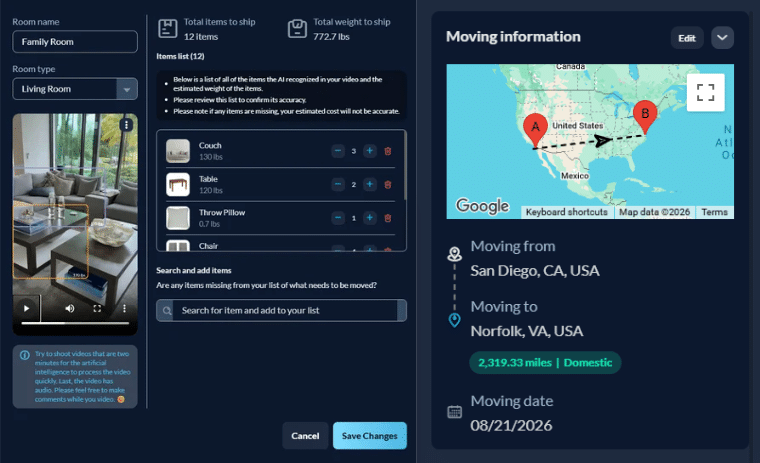
Knowing your allowance is only half the equation. The harder question is figuring out whether your belongings will actually fit under it, and how to hire the best movers.
That’s where a new free app called Agoyu changes everything.
Instead of gambling on one company, Agoyu connects you with multiple vetted, competitive moving companies—giving you accurate quotes, transparent pricing, and the power to choose. Compare real rates from the best movers in your area, read verified reviews, and select the company that fits your needs and budget.
With the AI moving app AGOYU, you can estimate your household goods and moving costs using your phone — before you ever talk to a mover.
Military members: enter promo code “PCS100” for military discounts.

What Counts Toward Your PCS Weight Allowance — and What Can You Ship?
Most household goods shipped as part of your PCS count toward your authorized weight. But military moves have special rules for certain belongings, and some surprisingly heavy items can eat into your allowance quickly.
Motorcycles and Dirt Bikes
Motorcycles and dirt bikes can generally be shipped as household goods. When they are, their weight counts toward your total authorized HHG weight. For some OCONUS moves, a motorcycle may instead be transported as your privately owned vehicle (POV), subject to destination requirements.
Spare Vehicle Parts
Spare POV parts also count toward your household goods allowance. That can include items such as engines, transmissions, seats, tops, winches and spare tires. If you’re close to your weight limit, don’t overlook several hundred pounds of vehicle parts sitting in the garage.
Utility Trailers, ATVs, Golf Carts and Similar Vehicles
Qualifying utility trailers and miscellaneous vehicles such as ATVs, golf carts and snowmobiles may be shipped as household goods, but their weight is included in your total HHG allowance. Size and configuration requirements can apply, so verify eligibility with your transportation office.
Boats and Personal Watercraft
Smaller boats and personal watercraft may qualify for shipment with your household goods. Larger boats involve additional procedures and can result in member-paid packing, handling or transportation costs. Discuss the move with your transportation office before scheduling anything.
Household Appliances and TVs
Household appliances and televisions are generally allowed in an HHG shipment. You are normally responsible for costs associated with disconnecting and reconnecting appliances or mounted televisions. Special crating rules may apply to particularly large televisions.
Firearms and Alcohol
Firearms and alcohol may generally be transported as part of a household goods shipment when applicable laws, destination requirements and shipping rules are followed. Restrictions can vary significantly—especially for OCONUS moves—so discuss these items with your transportation office.
What About Pets?
Live animals cannot be shipped as household goods by your moving company. Pet transportation is handled separately from your HHG shipment and may involve its own PCS allowances and reimbursement rules.
Professional Gear (Pro-Gear)
Professional books, papers and equipment—often called pro-gear or PBP&E—receive special treatment when they meet the applicable requirements.
Service members may move up to 2,000 pounds of qualifying professional gear, while spouses may move up to 500 pounds. Qualifying spouse pro-gear can also include homeschooling materials such as atlases, science kits and models.
Examples may include professional or military reference materials, job-specific tools and instruments, specialized professional clothing, military communications equipment, and individually owned or issued gear.
Make sure pro-gear is properly identified and documented during the moving process rather than assuming it will automatically be excluded from your ordinary HHG calculation.
Special Consumables Allowance for Some Remote Assignments
Service members assigned to certain qualifying remote duty stations may also be authorized to ship consumable goods in addition to their normal household goods.
For locations included in the Authorized Consumable Goods Allowance, the allowance can be up to 1,250 pounds per 12 months of the assignment. For example, an 18-month qualifying tour could authorize 1,875 pounds.
Consumables must be packed, marked and weighed separately. Not every OCONUS assignment qualifies. Check your orders, the current JTR Authorized Consumable Goods Allowance and your transportation office before purchasing or shipping consumables.
What Happens If You Exceed Your PCS Weight Allowance?
If your shipment exceeds your authorized PCS weight allowance, you can be responsible for the excess transportation cost—and you may not receive that bill until after your household goods have been delivered.
That makes estimating your shipment before packing especially important. Estimate early, identify unusually heavy items, declutter belongings you don’t need, properly identify qualifying pro-gear, and confirm unusual items with your transportation office.
Remember that a pre-move weight calculation is still an estimate. Your shipment’s official weight ultimately determines whether you’ve exceeded your allowance.
Special PCS Weight Rules and Exceptions
The standard grade-based PCS table is a starting point, not a universal answer.
OCONUS Moves
Certain overseas duty locations have administratively reduced HHG weight allowances based on local conditions such as available housing. Don’t assume the standard allowance for your grade automatically applies at every OCONUS destination.
Retirement and Separation Moves
Retiring and separating service members can have different entitlements, time limits and storage rules than members completing a standard PCS.
Unaccompanied Baggage
Unaccompanied baggage (UAB) is different from your standard PCS household goods shipment. It generally allows certain necessary personal items to arrive separately from the bulk of your household goods and can be subject to its own authorization and weight limitations. Don’t confuse UAB or TDY baggage limits with the much larger standard PCS HHG allowances shown above.
Can You Split Your PCS Weight Allowance Between Multiple Shipments?
Yes. Your total allowable household goods weight can generally be split between multiple shipments or moving methods.
For example, many service members completing a CONUS PCS use both a government-arranged HHG shipment and a Personally Procured Move (PPM), formerly called a DITY move, for some of their belongings (See an easy DITY/PPM move calculator here).
The combined weight and reimbursement rules still matter, so coordinate your plan with your transportation office before committing to movers or assuming a particular expense will be reimbursed.
How to Stay Under Your PCS Weight Allowance
- Estimate your weight early—don’t wait until everything is boxed.
- Go room by room. Heavy furniture, garages, home gyms and storage areas add up fast.
- Declutter aggressively. Moving something you don’t want anymore wastes both weight and space.
- Don’t forget the garage. Motorcycles, spare parts, tools and recreational equipment can represent hundreds or thousands of pounds.
- Separate and document pro-gear.
- Check destination-specific restrictions, particularly for OCONUS assignments.
- Plan multiple shipments carefully if you’re combining an HHG shipment with a PPM.
- Use a complete PCS move checklist so weight isn’t the only important detail that catches you by surprise.
Official PCS Weight Allowance Rules: Joint Travel Regulations
The Joint Travel Regulations are the official source for military travel and transportation allowances. Find even more information here:
- Official Joint Travel Regulations — Defense Travel Management Office
- JTR PCS & Household Goods Supplements
Are You Buying or Selling a Home During Your PCS?
Moving your belongings is only one part of a PCS. If you will be buying or selling a home in conjunction with your move, ARC can help.
USAA previously offered a popular military real estate rewards program that helped connect military members and their families with real estate professionals during a move. ARC offers a similar military-focused program designed to help service members navigate the home buying or selling process and connect with experienced real estate professionals. Military members using this program are given thousands of dollars back in the form of a realtor rebate. Register here for a benefit that you are already entitled to.