If you’re in the market for a new home, you’re probably looking for ways to save money on your purchase. One way to do this is through rebate programs offered by lenders like Navy Federal Credit Union.
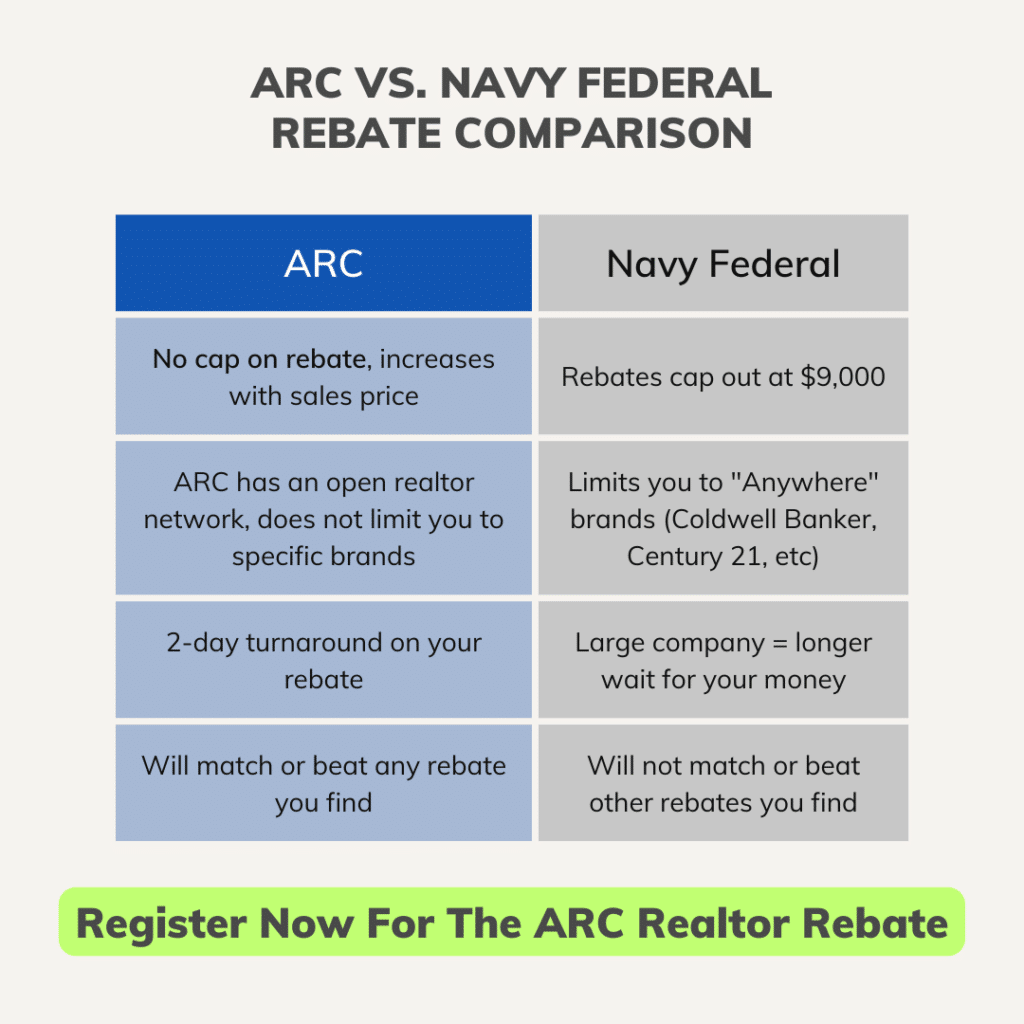
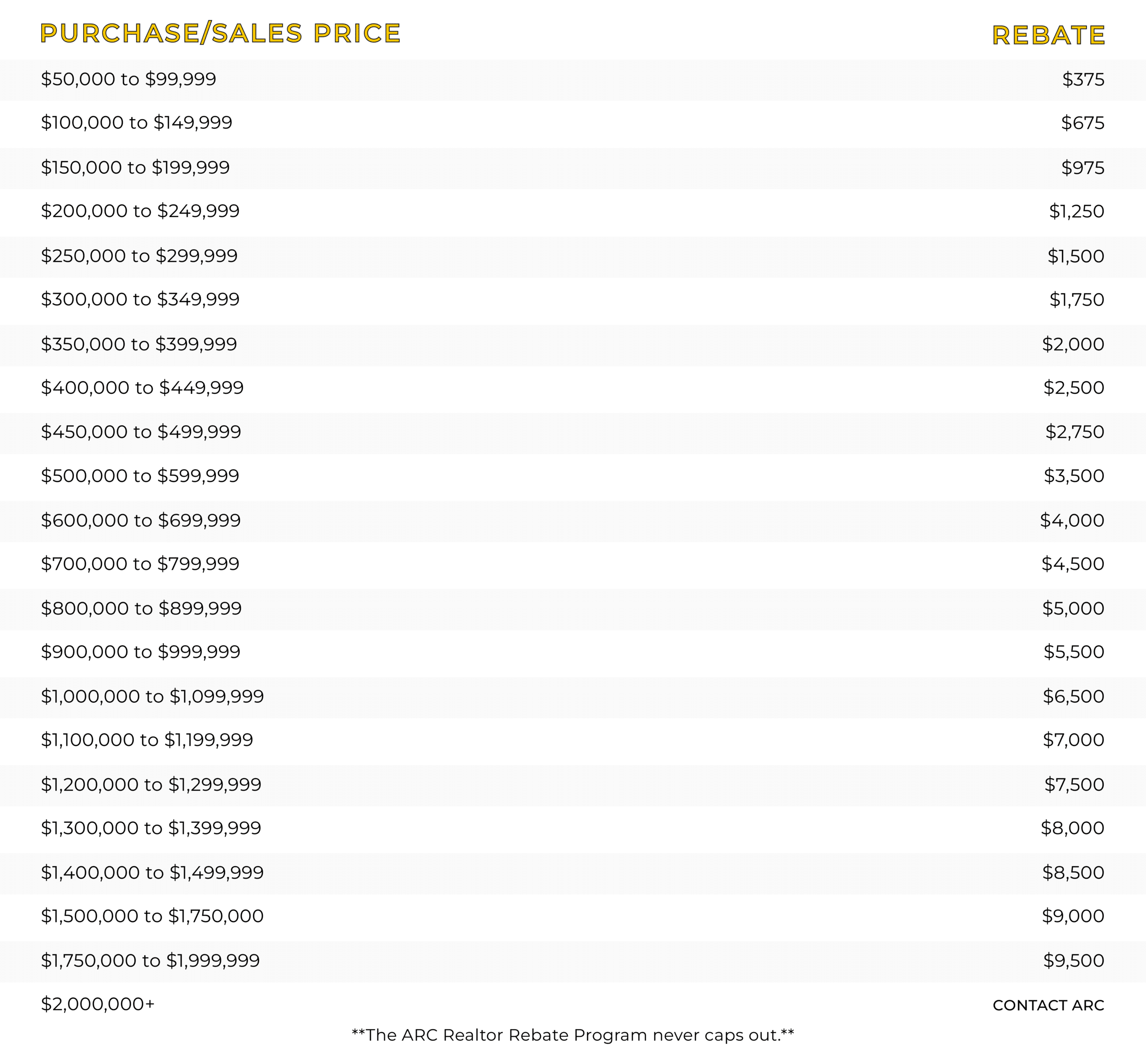
The goal of this article is to compare the Navy Federal Realty Plus Program to the ARC Realtor Rebate program to help you understand which is the better option for you. This chart below breaks down the benefits of the ARC Realtor Rebate Program compared to the Navy Fed program.
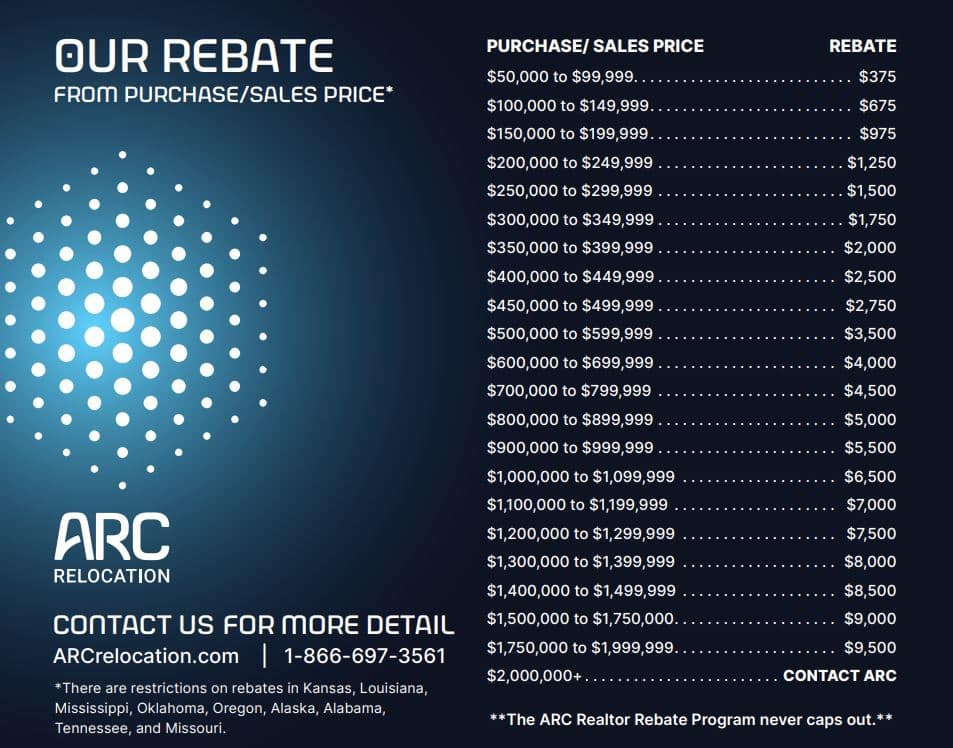
Generally, rebates range from a few hundred dollars to several thousand dollars. ARC and your real estate agent can help you determine the exact amount of your rebate.
Benefits of the ARC Realtor Rebate Program vs. Navy Federal
The ARC Realtor Rebate Program is a rebate program offered to help reduce the cost of buying a home. The program provides a rebate to members who use a real estate agent or broker affiliated with the network to purchase or sell a home.
Quick and Easy Sign Up, Fast Turnarounds
Find an affiliated agent: Once you’ve confirmed your eligibility, you’ll need to find an agent or broker who’s affiliated with the program. We have a huge network of realtors.
Work with the agent: Once you’ve chosen an agent, you’ll work with them to buy or sell your home.
Close on your home: Once you’ve closed on your home, you’ll need to submit a rebate request form to receive your rebate.
Receive your rebate: After you’ve submitted your rebate request form, you’ll receive your rebate in the form of a check or direct deposit in as little as two days.
Understanding the Navy Federal Realty Plus Program
The Navy Federal Realty Plus Program is a rebate program offered by Navy Federal Credit Union.
The program provides a rebate to members who use a real estate agent affiliated with Navy Federal Realty Plus to purchase or sell a home. The rebate amount varies, but can range from hundreds to thousands of dollars.
How to Sign Up for the Navy Federal Realty Plus Program
Become a Navy Federal Credit Union member: To be eligible for the program, you need to be a member of Navy Federal Credit Union. You can apply for membership on their website if you’re not already a member.
Find an affiliated agent: Once you’ve become a Navy Federal Credit Union member, you’ll need to find a real estate agent who’s affiliated with the Navy Federal Realty Plus Program. You can find a list of affiliated agents who are military relocation professionals on their website.
Work with the agent: Once you’ve chosen an agent, you’ll work with them to buy or sell your home.
Close on your home: Once you’ve closed on your home, you’ll need to submit a rebate request form to receive your rebate.
Receive your rebate: After you’ve submitted your rebate request form, you’ll receive your rebate in the form of a check or direct deposit.
Rebates for the Navy Federal Realty Plus Program
The amount of the rebate you receive through the Navy Federal Realty Plus Program varies depending on the purchase or sale price of the home. For example, if you purchase a home for $300,000, you could receive a rebate of $1,500. If you purchase a home for $500,000, you could receive a rebate of $3,000.
ARC Realtor Rebate Program vs the Navy Federal Realty Plus Program
So, how do the ARC Realtor Rebate Program and the Navy Federal Realty Plus Program stack up against each other?
Pros of the Navy Federal Realty Plus Program
Easy eligibility: To be eligible for the program, you only need to be a member of Navy Federal Credit Union.
Wide range of properties: The program’s affiliated agents have access to a wide range of properties, including foreclosures and short sales. This means that you can find a home that meets your needs and budget.
Professional guidance: By working with an affiliated agent, you’ll receive professional guidance and advice throughout the home buying or selling process.
Cons of the Navy Federal Realty Plus Program
Limited eligibility: The program is only available to members of Navy Federal Credit Union.
Limited agent options: The program only works with a specific group of real estate agents who are affiliated with Navy Federal Credit Union.
Limited geographical coverage: The program is only available in certain areas.
Pros of the ARC Realtor Rebate Program
No credit union or bank membership required: Unlike other rebate programs, the ARC Rebate Program is open to members of any credit union or bank.
Higher rebates: Depending on the purchase or sale price of the home, you could receive hundreds or even thousands of dollars in rebates through the program. There is no cap on our rebates.
Wide range of properties: The program’s affiliated agents have access to a wide range of properties, including foreclosures and short sales.
Faster Turnarounds: We’re a smaller company so we’re able to get your rebate paid to you in as little as two days.
Cons of the ARC Realtor Rebate Program
Not designed specifically for service members, veterans of any branch of the armed forces, or Department of Defense employees but for anybody looking to buy or sell a home.
Conclusion
The ARC Realtor Rebate Program offers wide eligibility, as it’s open to any credit union or bank members. This can give you more options for finding the right home or buyer. It can be a valuable tool for anyone who is looking to save money on their home purchase or sale.
If you’re planning to buy or sell a home, the ARC Realtor Rebate is a great way to save money on the process. We offer higher rebates, a larger network, and a faster turnaround. Register today to get started!
If you want to buy or sell a home, you may have heard of the Berkshire Hathaway PenFed Realty Program and the ARC Realtor Rebate Program.
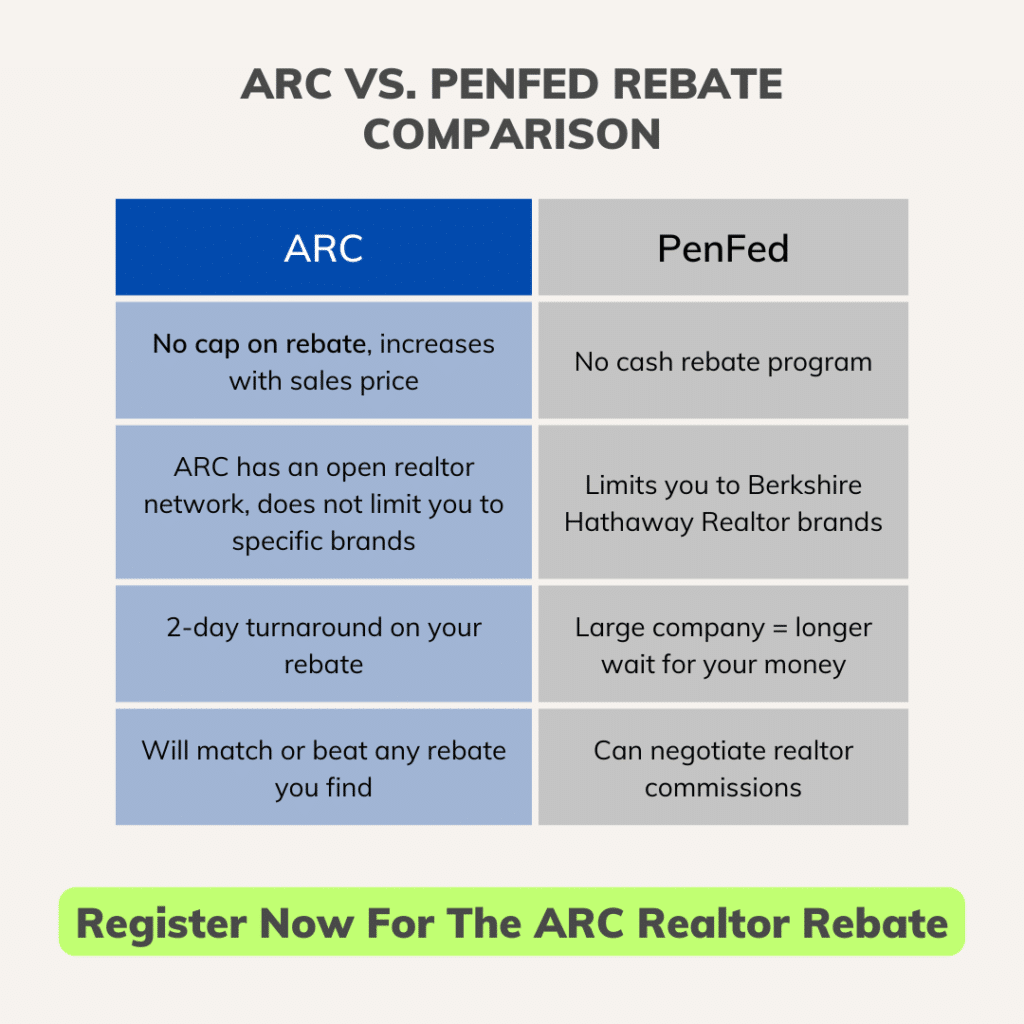
Both of these programs benefit homebuyers but the ARC Realtor Rebate offers more money, faster turnarounds, and a larger real estate network for you to choose from. Check out the chart below to learn more.
The ARC Realtor Rebate Program offers home buyers and sellers a cash rebate. The rebate is a percentage of the home’s sale price and is paid directly to the client after closing. ARC’s program is designed to help offset some of the costs associated with moving, including selling a current home and purchasing a new one.
Higher Rebates vs PenFed Realty
The rebate amount varies depending on the home’s sale price. Generally, the rebates can range from hundreds of dollars to thousands of dollars. Keep in mind that we’ll match any rebate you get from another company so this chart is just a benchmark to give you an idea.
To be eligible for the ARC Rebate Program, you must work with a real estate agent affiliated with the ARC Relocation network. They will guide you through buying or selling a home and work with ARC to help you get the rebate. Above and beyond that, however, It is easy to sign up for the ARC Rebate Program, by submitting some very basic contact information.
Understanding the Berkshire Hathaway Homeservices Penfed Realty Program
The PenFed Realty Program is a real estate brokerage firm that offers services to buyers and sellers. It is part of the Berkshire Hathaway HomeServices network, one of the world’s largest real estate brokerage networks.
PenFed Realty offers many services, including home buying and selling, mortgage services, and property management. They also provide a network of experienced agents who can help clients with all aspects of the real estate transaction.
How to Sign Up for the PenFed Realty Program
To sign up for the PenFed Realty Program, visit their website. Fill out the form with your contact information, and a PenFed Realty representative will contact you to discuss your options.
Rebates for the PenFed Realty Program
The PenFed Realty Program does not offer cash rebates to clients. Instead, they offer competitive commission rates to their agents, which can help clients save money on their real estate transactions.
ARC Realtor Rebate Program vs PenFed Realty Program
The ARC Realtor Rebate Program and the PenFed Realty Program offer different benefits to clients.
The program offers a cash rebate to home buyers and sellers, whether for work relocation, military relocation, or moving for personal reasons. The PenFed Realty Program provides competitive commission rates to their agents.
Cons of the PenFed Realty Program
They do not offer rebates to clients
Limit you to Berkshire Hathaway brands
Longer turnaround times
Pros of the ARC Realtor Rebate Program
Cash rebates with no cap, rebate increases as sale price increases
Faster turnarounds in as little as two days
We’ll match any rebate
ARC has an open realtor network which increases your options
Available in all 50 states
Conclusion
Both the ARC Realtor Rebate Program and the PenFed Realty Program benefit clients and agents alike. The ARC Realtor Rebate Program provides a cash rebate to clients, while the PenFed Realty Program offers its agents a wide range of services, they don’t offer rebates.
Clients should consider their individual needs and preferences when choosing between these programs. With generous cash rebate amounts, the ARC Rebate Program is an excellent choice for anyone buying or selling a home or relocating for work looking to save money.
DITY Move Calculator: Estimate Your Military Move Reimbursement
Starting in January of 2021, the military decided to increase the reimbursement amount for moving expenses from 95 to 100 percent. This means that the government will pay 100 percent of your expenses in the event of a PCS.
For those who are organized and great at managing money, you can go through the entire move and actually end up with money left over on the other side.
A PPM calculator can help you do this by helping to calculate the total expenses of your move while factoring in your reimbursements or allowances.
Our DITY move calculator will provide you with estimates for all branches including: Navy, Army, Marines, Air Force, Coast Guard, and Space Force.
Updated with 2026 DoD rates
DITY / PPM Move Calculator
Estimate what you could pocket on a Personally Procured Move — the incentive payment plus your DLA, mileage, and per diem allowances.
Age 12+ (include spouse)
Under 12
With-dependent rates applied.
Use the official DTOD distance from your orders when you have it.
Your weight allowance: —. Reimbursement is capped at this weight.
MALT is paid per authorized vehicle, regardless of passengers.
Auto-calculated from distance.
Everything you’ll actually spend to move yourself. Keep every receipt.
Auto-estimated from your weight and distance. The exact figure comes from your TMO / move.mil counselor — drop it in here for a precise result.
This tool provides estimates only using published 2026 DoD rates (DLA per DTMO MAP 72-25(I), MALT $0.205/mile, standard CONUS per diem, JTR weight allowances). The PPM incentive is an approximation of the Government Constructed Cost; your actual payment, entitlements, and tax treatment depend on your orders, official DTOD distance, and finance-office approval. Verify everything at move.mil and travel.dod.mil. ARC Relocation is a private third-party company, not a government or military entity.
Now make your move pay off
Two smart moves once you know your numbers
Find movers the smart way
Doing a PPM or hiring out part of it? Skip the phone tag. Agoyu is a free AI app that pulls fast, accurate quotes from local movers so you can compare and book in minutes.
Put thousands back in your pocket at closing with our military realtor rebate program. It’s cash back on the home you’re already buying or selling for your move.
A personally procured move has a lot of moving parts, but the math behind it is simple once you know your numbers. Fill in the fields with the details from your PCS orders and your own move plan, and the calculator handles the rest. It updates as you type, so you can adjust any figure and watch your estimate change right away.
Step 1: Enter your move details
Pay grade. Pick your grade from the list. This sets two things at once: your Dislocation Allowance and your household goods weight allowance. Prior-enlisted officers have their own entries (O-1E, O-2E, O-3E), so use those if they apply to you.
Dependents moving with you. Enter how many dependents are relocating, split by age, and count your spouse as a dependent age 12 or older. Having dependents on your orders moves you to the higher DLA and weight allowance, and each traveler adds to your per diem.
Distance to your new duty station. Enter the mileage between your old and new bases. Once you have your orders, use the official DTOD distance instead of a figure from a maps app, since that's the number finance pays on. This drives your mileage reimbursement, your travel days, and your government payment estimate.
Estimated weight you'll move. Enter how many pounds of household goods you plan to move yourself. The calculator shows your weight allowance right below the field and caps your reimbursement there, so anything over that limit won't add to your payment. A quick way to estimate: figure about 1,500 pounds per furnished room, then add the weight of your large appliances.
Vehicles you'll drive. Choose how many vehicles you're driving to the new station. Mileage is paid per authorized vehicle, so two cars earn more than one. Pick "none" if you're flying.
Authorized travel days. The calculator fills this in for you based on distance, using the standard rule of one day for the first 400 miles and one more for each additional 350. If your orders authorize a different number, type it in. The "reset to auto" link puts the calculated figure back.
Your estimated moving costs. Enter everything you expect to spend to move yourself: truck or trailer rental, fuel, packing supplies, moving help, tolls, and lodging on the road. This is the number that decides how much of your government payment you actually keep, so be realistic and save every receipt.
Estimated government payment (GCC). The calculator estimates this for you from your weight and distance. If your transportation office or move.mil counselor has already given you an official figure, type it in for a sharper result. The "reset to auto" link returns to the estimate.
Step 2: Read your results
The large number at the top is your estimated money in your pocket. It combines two very different kinds of money, and the breakdown below it keeps them separate on purpose.
The PPM incentive is your profit for moving yourself. It starts with the government payment, subtracts what you spend on the move, then subtracts roughly 22 percent for taxes, since this profit counts as taxable income. What's left is yours.
The allowances are the DLA, mileage, and per diem you receive no matter how you move. These are non-taxable, and you collect them whether you do a PPM or let the government ship your goods. That's why they sit in their own section rather than getting mixed in with your profit.
Updated with 2026 DoD rates
DITY / PPM Move Calculator
Estimate what you could pocket on a Personally Procured Move — the incentive payment plus your DLA, mileage, and per diem allowances.
Age 12+ (include spouse)
Under 12
With-dependent rates applied.
Use the official DTOD distance from your orders when you have it.
Your weight allowance: —. Reimbursement is capped at this weight.
MALT is paid per authorized vehicle, regardless of passengers.
Auto-calculated from distance.
Everything you'll actually spend to move yourself. Keep every receipt.
Auto-estimated from your weight and distance. The exact figure comes from your TMO / move.mil counselor — drop it in here for a precise result.
This tool provides estimates only using published 2026 DoD rates (DLA per DTMO MAP 72-25(I), MALT $0.205/mile, standard CONUS per diem, JTR weight allowances). The PPM incentive is an approximation of the Government Constructed Cost; your actual payment, entitlements, and tax treatment depend on your orders, official DTOD distance, and finance-office approval. Verify everything at move.mil and travel.dod.mil. ARC Relocation is a private third-party company, not a government or military entity.
Now make your move pay off
Two smart moves once you know your numbers
Find movers the smart way
Doing a PPM or hiring out part of it? Skip the phone tag. Agoyu is a free AI app that pulls fast, accurate quotes from local movers so you can compare and book in minutes.
Put thousands back in your pocket at closing with our military realtor rebate program. It's cash back on the home you're already buying or selling for your move.
It comes down to three things: your weight allowance, the distance of your move, and how cheaply you can move yourself. Most service members clear somewhere between $2,000 and $8,000 in profit, and long, heavy moves done on a tight budget can run higher. The calculator above gives you a number for your own situation, but the pattern always holds. The more weight you move under your allowance, and the less you spend doing it, the more you keep.
Is my PPM profit taxable?
Yes. Whatever is left of your government payment after your documented moving costs counts as taxable income, and finance withholds a flat 22 percent when they pay you. That withholding comes off the full payment up front, which is why keeping every receipt matters. Active-duty members can still deduct unreimbursed PCS moving costs at tax time on IRS Form 3903, which lowers your taxable profit and often returns part of that withholding as a refund. Your DLA, mileage, and per diem are separate from all of this and stay non-taxable.
What happens if I move more than my weight allowance?
On a PPM, the government pays you only up to your authorized weight, so any pounds over that limit earn nothing extra. The upside is that you won't be billed for the overage the way you would on a government-arranged move, where excess weight becomes a debt. Weigh your loaded and empty vehicle at a certified scale and keep the tickets, since your entire payment is built on that certified weight.
Can I do a partial PPM instead of moving everything myself?
Yes, and plenty of families choose this route. You can let the government ship your heavy furniture and appliances while you personally move the lighter, higher-value items like electronics, tools, and important documents. You still get paid for the portion you move yourself, so it's a lower-effort way to earn part of the profit without loading a 26-foot truck across the country.
Do I get paid before the move or only after?
You can request an advance of up to 60 percent of your estimated payment through your transportation office once your orders are approved. That advance helps cover the truck, fuel, and supplies so you're not fronting the whole move out of your own pocket. The remaining balance is paid after you turn in your completed paperwork and weight tickets at your new duty station.
What paperwork do I need to get reimbursed?
Start with approval from your transportation office before you move a single box, because a PPM without pre-approval usually can't be paid. After that you'll need your PCS orders, certified empty and full weight tickets for each trip, receipts for your moving costs, and your completed travel voucher. File everything promptly once you report in, and keep copies for tax season so you can claim your expenses later.
When a service member is being relocated for a timespan of longer than 20 weeks, this is considered a permanent change of station or PCS. These moves happen all the time and military service members are called upon to relocate to new assignments as frequently as once every couple of years.
If you or a member of your staff are going through a PCS, it’s important to understand your PCS weight allowance to make sure you stay compliant so you don’t have to pay any extra money out of pocket. Exceeding your authorized weight can leave you responsible for the excess transportation cost, so it pays to know your number before you start packing.
Your PCS household goods (HHG) weight allowance is primarily determined by your pay grade and whether you have dependents on the effective date of your PCS orders. Your move type and destination can also affect what you’re authorized to ship.
Use the chart below to find your standard PCS weight allowance, then learn what counts toward it, which items receive special treatment, and how to avoid going overweight.
PCS Weight Allowance by Pay Grade
The standard PCS household goods allowances below are based on the Joint Travel Regulations (JTR), the official source for military travel and transportation entitlements.
Grade
Without Dependents
With Dependents
O-10 through O-6
18,000 lbs.
18,000 lbs.
O-5 / W-5
16,000 lbs.
17,500 lbs.
O-4 / W-4
14,000 lbs.
17,000 lbs.
O-3 / W-3
13,000 lbs.
14,500 lbs.
O-2 / W-2
12,500 lbs.
13,500 lbs.
O-1 / W-1 / Service Academy Graduates
10,000 lbs.
12,000 lbs.
E-9
13,000 lbs.
15,000 lbs.
E-8
12,000 lbs.
14,000 lbs.
E-7
11,000 lbs.
13,000 lbs.
E-6
8,000 lbs.
11,000 lbs.
E-5
7,000 lbs.
9,000 lbs.
E-4
7,000 lbs.
8,000 lbs.
E-3 and below
5,000 lbs.
8,000 lbs.
Aviation Cadets
7,000 lbs.
8,000 lbs.
Service Academy Cadets/Midshipmen
350-lb. TDY allowance
—
*Important: Your PCS orders and transportation office determine your actual entitlement. Special allowances or restrictions can apply based on your assignment, duty location and move type.
How Much Does Your Household Goods Shipment Weigh?
Military members easily estimate their PCS moving weight and cost with AGOYU, the free AI moving app.
Knowing your allowance is only half the equation. The harder question is figuring out whether your belongings will actually fit under it, and how to hire the best movers.
That’s where a new free app called Agoyu changes everything.
Instead of gambling on one company, Agoyu connects you with multiple vetted, competitive moving companies—giving you accurate quotes, transparent pricing, and the power to choose. Compare real rates from the best movers in your area, read verified reviews, and select the company that fits your needs and budget.
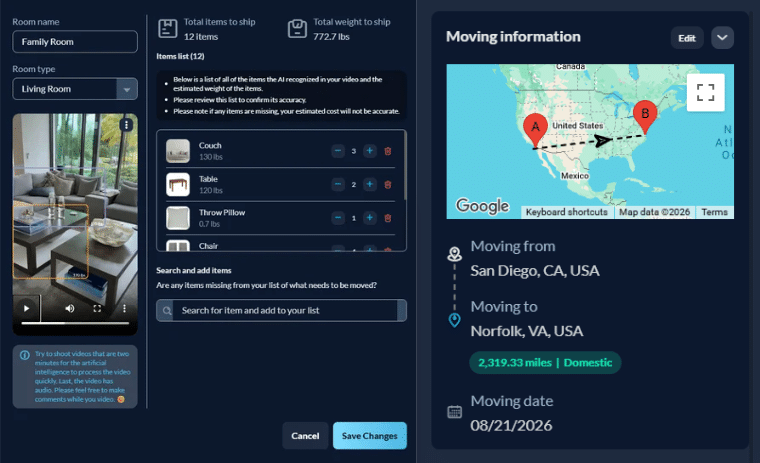
With the AI moving app AGOYU, you can estimate your household goods and moving costs using your phone — before you ever talk to a mover.
Military members: enter promo code “PCS100” for military discounts.
What Counts Toward Your PCS Weight Allowance — and What Can You Ship?
Most household goods shipped as part of your PCS count toward your authorized weight. But military moves have special rules for certain belongings, and some surprisingly heavy items can eat into your allowance quickly.
Motorcycles and Dirt Bikes
Motorcycles and dirt bikes can generally be shipped as household goods. When they are, their weight counts toward your total authorized HHG weight. For some OCONUS moves, a motorcycle may instead be transported as your privately owned vehicle (POV), subject to destination requirements.
Spare Vehicle Parts
Spare POV parts also count toward your household goods allowance. That can include items such as engines, transmissions, seats, tops, winches and spare tires. If you’re close to your weight limit, don’t overlook several hundred pounds of vehicle parts sitting in the garage.
Utility Trailers, ATVs, Golf Carts and Similar Vehicles
Qualifying utility trailers and miscellaneous vehicles such as ATVs, golf carts and snowmobiles may be shipped as household goods, but their weight is included in your total HHG allowance. Size and configuration requirements can apply, so verify eligibility with your transportation office.
Boats and Personal Watercraft
Smaller boats and personal watercraft may qualify for shipment with your household goods. Larger boats involve additional procedures and can result in member-paid packing, handling or transportation costs. Discuss the move with your transportation office before scheduling anything.
Household Appliances and TVs
Household appliances and televisions are generally allowed in an HHG shipment. You are normally responsible for costs associated with disconnecting and reconnecting appliances or mounted televisions. Special crating rules may apply to particularly large televisions.
Firearms and Alcohol
Firearms and alcohol may generally be transported as part of a household goods shipment when applicable laws, destination requirements and shipping rules are followed. Restrictions can vary significantly—especially for OCONUS moves—so discuss these items with your transportation office.
What About Pets?
Live animals cannot be shipped as household goods by your moving company. Pet transportation is handled separately from your HHG shipment and may involve its own PCS allowances and reimbursement rules.
Professional Gear (Pro-Gear)
Professional books, papers and equipment—often called pro-gear or PBP&E—receive special treatment when they meet the applicable requirements.
Service members may move up to 2,000 pounds of qualifying professional gear, while spouses may move up to 500 pounds. Qualifying spouse pro-gear can also include homeschooling materials such as atlases, science kits and models.
Examples may include professional or military reference materials, job-specific tools and instruments, specialized professional clothing, military communications equipment, and individually owned or issued gear.
Make sure pro-gear is properly identified and documented during the moving process rather than assuming it will automatically be excluded from your ordinary HHG calculation.
Special Consumables Allowance for Some Remote Assignments
Service members assigned to certain qualifying remote duty stations may also be authorized to ship consumable goods in addition to their normal household goods.
For locations included in the Authorized Consumable Goods Allowance, the allowance can be up to 1,250 pounds per 12 months of the assignment. For example, an 18-month qualifying tour could authorize 1,875 pounds.
Consumables must be packed, marked and weighed separately. Not every OCONUS assignment qualifies. Check your orders, the current JTR Authorized Consumable Goods Allowance and your transportation office before purchasing or shipping consumables.
What Happens If You Exceed Your PCS Weight Allowance?
If your shipment exceeds your authorized PCS weight allowance, you can be responsible for the excess transportation cost—and you may not receive that bill until after your household goods have been delivered.
That makes estimating your shipment before packing especially important. Estimate early, identify unusually heavy items, declutter belongings you don’t need, properly identify qualifying pro-gear, and confirm unusual items with your transportation office.
Remember that a pre-move weight calculation is still an estimate. Your shipment’s official weight ultimately determines whether you’ve exceeded your allowance.
Special PCS Weight Rules and Exceptions
The standard grade-based PCS table is a starting point, not a universal answer.
OCONUS Moves
Certain overseas duty locations have administratively reduced HHG weight allowances based on local conditions such as available housing. Don’t assume the standard allowance for your grade automatically applies at every OCONUS destination.
Retirement and Separation Moves
Retiring and separating service members can have different entitlements, time limits and storage rules than members completing a standard PCS.
Unaccompanied Baggage
Unaccompanied baggage (UAB) is different from your standard PCS household goods shipment. It generally allows certain necessary personal items to arrive separately from the bulk of your household goods and can be subject to its own authorization and weight limitations. Don’t confuse UAB or TDY baggage limits with the much larger standard PCS HHG allowances shown above.
Can You Split Your PCS Weight Allowance Between Multiple Shipments?
Yes. Your total allowable household goods weight can generally be split between multiple shipments or moving methods.
For example, many service members completing a CONUS PCS use both a government-arranged HHG shipment and a Personally Procured Move (PPM), formerly called a DITY move, for some of their belongings (See an easy DITY/PPM move calculator here).
The combined weight and reimbursement rules still matter, so coordinate your plan with your transportation office before committing to movers or assuming a particular expense will be reimbursed.
How to Stay Under Your PCS Weight Allowance
Estimate your weight early—don’t wait until everything is boxed.
Go room by room. Heavy furniture, garages, home gyms and storage areas add up fast.
Declutter aggressively. Moving something you don’t want anymore wastes both weight and space.
Don’t forget the garage. Motorcycles, spare parts, tools and recreational equipment can represent hundreds or thousands of pounds.
Separate and document pro-gear.
Check destination-specific restrictions, particularly for OCONUS assignments.
Plan multiple shipments carefully if you’re combining an HHG shipment with a PPM.
Use a complete PCS move checklist so weight isn’t the only important detail that catches you by surprise.
Official PCS Weight Allowance Rules: Joint Travel Regulations
The Joint Travel Regulations are the official source for military travel and transportation allowances. Find even more information here:
Moving your belongings is only one part of a PCS. If you will be buying or selling a home in conjunction with your move, ARC can help.
USAA previously offered a popular military real estate rewards program that helped connect military members and their families with real estate professionals during a move. ARC offers a similar military-focused program designed to help service members navigate the home buying or selling process and connect with experienced real estate professionals. Military members using this program are given thousands of dollars back in the form of a realtor rebate. Register here for a benefit that you are already entitled to.
Ask any financial advisor about the most powerful mortgage options for active service members, as well as veterans. They will point out the VA loan program as the best option.
Quite simply, a VA home loan has multiple advantages over a conventional loan, and millions of veterans have benefited from it.
Here, we discuss what is a VA home loan and how can you apply for it.
Buying or Selling a Home?
Register Below for Your Cash Back Rebate Worth Thousands of Dollars After Closing!
(a benefit you are already entitled to)
What is a VA Home Loan?
A VA loan is backed by the U.S. Department of Veteran Affairs (VA). The origin of the loan program can be traced back to the 1944 GI Bill of Rights. It was signed into law to help veterans enter civilian life after World War II. Since then, the department has backed over 24 million VA home loans.
The purpose of a VA home loan is to make homeownership easier for those who have served. A VA loan has multiple advantages that make it the safest loan option on the market. Here are a few of them.
Probably, the biggest advantage of a VA loan is that it allows you to buy a home with a 0% down payment. In comparison, the average home buyer has to make a 6% upfront payment.
In addition, VA loans do not require you to pay monthly private mortgage insurance (PMI). For conventional loans, borrowers need to pay this amount if they can’t make the necessary downpayment.
The average interest rate on VA loans is lower than the market. Not only does this lead to more savings, but it also qualifies veterans for a larger loan amount.
In general, VA loans have lower credit score requirements than other loans. Likewise, the cutoff for the debt-to-income ratio is more forgiving. This makes it a more flexible option.
There is a limit on the various fees that the lender can charge as VA loan closing costs. These include attorney fees and mortgage origination fees.
Borrowers can pay off their VA loan at any point without having to worry about prepayment penalties.
How Does a VA Home Loan Work
Veterans and active service members can use the VA loan for buying, building, or improving a house. The VA does not directly provide the majority of the home loans. Private lenders like mortgage companies, credit unions, or banks backed by the VA provide the loans.
If you have full entitlement, then there are no limits on a VA loan. The lender will know that in case of a default on a loan, the VA will pay them up to 25% of the loan. This allows the lender to recover some of the loan amount, in case of a loan foreclosure.
Coming to the eligibility criteria, you will need a Certificate of Eligibility (COE) to prove your eligibility for the loan. You can submit your service-related documentation and get the certificate from the VA website.
During processing, the lender requests a VA appraisal of the house to estimate its market value. This report and your credit and income information are evaluated to determine if you can repay the loan.
Firstly, you need to meet the length-of-service requirements. This is 90 continuous days of active duty for service members. For veterans, the minimum service requirement depends on the service time. Those who have served in the National Guard or Reserve for at least six years are also eligible.
Surviving spouses of service members who have died on active duty or due to a service-connected disability are eligible, provided they have not re-married before December 16, 2003.
While the VA has no required credit score limit, you need to meet the minimum standard set by the lenders.
The property you wish to buy should be your primary residence and meet all the building codes, as well as safety standards.
If your discharge was other than honorable, or due to bad conduct or dishonorable, you are not eligible.
A big plus of a VA loan is that it is not a one-time benefit. You can use it more than once and it is even possible to have multiple VA loans going at a time. However, the amount you can borrow will be limited by the partial or reduced entitlement you may have.
Understanding the Types of VA Home Loans
The two main types of VA home loans are the VA direct home loan and the VA-backed home loan, For a direct loan, the VA loans the amount directly to you and manages the loan. In a VA-backed home loan, the loan is provided by a private lender, while the VA guarantees a portion of it.
Listed below are some of the other VA loan options.
VA Renovation Loan
You can use this form of the VA loan to renovate and repair your home. These loans can also supplement a standard VA loan for property purchases. Note, that the renovation should not be for aesthetic purposes. Technically, it should improve the “livability, use, and safety” of your primary residence.
Native American Direct Loan
The Native American Direct Loan (NADL) is a VA-direct home loan available to Native American Veterans or a Veteran married to a Native American. The loan can be used to buy, build, or improve a primary residence. The NADL offers all the benefits of a typical VA home loan, including zero down payment and reduced closing costs.
Interest Rate Reduction Refinance Loan (IRRRL)
This is a great option for those already having a VA-backed home loan and looking to reduce their monthly mortgage payments. The loan can help you lower the interest rates on the existing loan or shift to a fixed-rate interest plan. This is not a VA-direct loan and you will have to approach a private bank, or a mortgage company for it.
Cash-out Refinance Loan
This VA-backed loan option can replace your existing loan with a new one with different conditions. Commonly, it is used to convert a non-VA loan into a VA-backed loan. Besides, with this loan, you can use your home equity to meet other expenses like paying off debt, paying for school, and more. To be eligible, you need to possess a Certificate of Eligibility and meet the financial standards set by the lender.
How to Apply for a VA Home Loan
Typically, the application process for a VA loan is similar to other loan types. Even so, a clear understanding of the process will help you to make the most of the benefits offered by a VA home loan.
Here is a quick breakdown of the VA loan application process.
The first step is to find out if you are eligible for a VA loan and understand the requirements.
Next, look around for the right lender approved by the U.S. Department of Veterans Affairs. Picking a lender who deals exclusively in VA loan programs can make the process easier. Shopping around for the right lender is a good way to save money on any mortgage or a VA loan.
The lender will go through your credit and financial history before preapproving the loan. Then you can apply for the Certificate of Eligibility (COE). Approved lenders can access this document for preapproval checking.
Once the loan is pre-approved, you can start hunting for a house. It is best to pick a veteran-friendly real estate agent who can help you get the most benefits from a VA loan. To maximize your savings, pick an American Realty Council (ARC)-affiliated agent to save money from the ARC Realtor Rebate program.
After a property is finalized, you can make an offer in consultation with the agent and your loan officer. Once the offer gets accepted, it’s time to sign a purchase agreement. Make sure to discuss the VA loan closing costs with your loan officer at this stage. You can also ask the lender for a mortgage rebate.
With the contract signed, it is time for the VA appraisal to ensure that the property meets the VA minimum property requirements. At the same time, you will need to submit the necessary documents to the lender. After the appraisal is complete, the loan is ready for closing.
Finally, you will need to sign the closing disclosure documents to complete the legal transfer of the property to you.
Final Thoughts
Without a doubt, a VA loan has some key advantages that make it one of the best options for veterans and service holders. No wonder the volume of VA loans has increased significantly in the last decade.
That said, VA loans come with some closing costs that you have to cover. One of the best ways to offset these costs is to choose the ARC realtor rebate program through an approved real estate agent. Through this program, you can save a considerable amount based on the purchase price. The best part is, that with higher transaction value, the rebate gets larger.
Moreover, while moving to a new home, you can save money through the ARC relocation Replacement USAA Movers Advantage program. The program offers great rebates for your move to the new home. Plus, ARc specializes in assisting veterans and military families with their moves.
Want to learn more? Discover more about our amazing realtor rebate program and maximize your savings.
FAQs
How many times can you use a VA home loan?
There are no limits on the number of times you can use a VA home loan. However, the amount you can borrow without making a downpayment depends on your remaining entitlement.
Why is it called the VA?
It is called a VA loan since the loan program is managed by the Department of Veterans Affairs (VA).
Why is a VA loan better?
A VA loan has multiple advantages including zero down payment and no mortgage insurance requirements. It also offers better flexibility in terms of credit score and debt load, compared to a conventional loan.
How much are closing costs in VA?
The closing costs for VA loans include multiple fees like the origination fee, funding fee, appraisal fee, VA funding fee, etc. The average closing costs can range between 1 to 6 percent of the loan amount.
Buying a home is a huge financial decision, and understanding the different mortgage options available is crucial.
Two popular choices are VA loans vs conventional loans, each with its own set of pros and cons. In this article, we’ll dive deep into the differences between these two loan types, so you can make an informed decision.
Buying or Selling a Home?
Register Below for Your Cash Back Rebate Worth Thousands of Dollars After Closing!
(a benefit you are already entitled to)
What Is a VA Loan vs Conventional Loan?
A VA loan is a mortgage loan program backed by the U.S. Department of Veterans Affairs, designed to help active-duty military personnel, veterans, and eligible surviving spouses buy, build, or refinance a home. VA loans have different eligibility requirements than a conventional loan, which is a mortgage that is not insured or guaranteed by the government.
VA Loan
VA loans offer a range of benefits, including no down payment requirement, competitive interest rates, and flexible credit requirements. These loans are available to eligible borrowers who meet the service requirements set by the VA.
Conventional Loan
Conventional loans are not backed by the government and are offered by private lenders. Conventional vs VA loans typically require a higher credit score and a larger down payment, but they also offer more flexibility in terms of loan amounts and property types.
Differences Between VA and Conventional Loans
While both VA and conventional loans serve the same purpose – helping you finance a home purchase – they differ in several key areas. The main points of distinction include:
Eligibility requirements
Down payment requirements
Credit score requirements
Mortgage insurance
Funding fees
Loan limits
This table helps to better outline the key differences between VA loans and conventional loans:
Feature
VA Loans
Conventional Loans
Eligibility
Exclusive to veterans, active-duty service members, and select military spouses.
Available to all borrowers.
Down Payment
No down payment required in most cases.
Down payment can vary, typically 3-20% or more.
Mortgage Insurance
No mortgage insurance required.
Private mortgage insurance (PMI) required with less than 20% down payment.
Loan Limits
Varies by county, but generally generous.
Limits vary by county and are generally higher for conventional loans.
Funding Fee
Required (can be financed into the loan), percentage varies based on various factors, such as the borrower’s military category and whether it’s a first-time use.
Not applicable.
Credit Score Requirements
Generally more flexible, with lower minimum scores accepted.
Typically requires a higher credit score.
Interest Rates
Typically lower compared to conventional loans.
Can vary based on credit score, down payment, and other factors.
Property Requirements
Must meet VA’s Minimum Property Requirements (MPRs).
Appraisal and property requirements can vary, generally less strict than VA.
Loan Types
Mainly for purchasing or refinancing primary residences.
Broad range, including primary residences, second homes, and investment properties.
Foreclosure Avoidance
Strong commitment to assisting borrowers avoid foreclosure.
Less support compared to VA loans.
Mortgage Requirements For Conventional Loans vs VA Loans
When comparing VA and conventional loans, it’s essential to understand the different mortgage requirements for each.
Down Payment
One of the most significant advantages of VA home loans vs conventional loans is that they often allow for little to no down payment. Conventional loans, on the other hand, typically require a down payment of at least 3%, but preferably 20% to avoid private mortgage insurance (PMI).
Credit Score
VA loans tend to have more flexible credit score requirements than conventional loans. While conventional lenders may require a credit score of 620 or higher, VA loans may be available to borrowers with lower scores, depending on their overall financial situation.
Private Mortgage Insurance
With a conventional loan, if you put less than 20% down, you’ll be required to pay private mortgage insurance (PMI). This additional cost can add up quickly over the life of the loan. VA loans, however, do not require PMI, regardless of the down payment amount.
Debt to Income Ratio
Both VA and conventional loans have debt-to-income ratio (DTI) requirements, but the VA’s guidelines are generally more lenient. The maximum DTI for a VA loan is typically around 41%, while conventional lenders may have stricter DTI limits.
Borrower Eligibility
VA loans are only available to eligible active-duty military personnel, veterans, and their spouses. Conventional loans, on the other hand, are available to any borrower who meets the lender’s credit and income requirements.
Property Eligibility
VA loans have specific property eligibility requirements, such as the home must be your primary residence and meet certain minimum property requirements. Conventional loans, while still having some restrictions, are generally more flexible in terms of property types and intended use.
Fees
VA loans come with a funding fee, which is a percentage of the loan amount that helps offset the cost of the VA loan program. Conventional loans may have various fees, such as origination fees and application fees, but they do not have a specific funding fee like VA loans.
Benefits of a VA Loan vs Conventional Loan
VA loans offer several benefits over conventional loans, including:
No down payment required (in most cases)
Lower credit score requirements
No private mortgage insurance (PMI)
Lower interest rates
Flexible underwriting guidelines
However, traditional mortgages vs VA loans also have their advantages, such as:
No eligibility restrictions based on military service
Fewer property restrictions
Potentially higher loan limits in some areas
How ARC’s Realtor Rebate Can Help
Regardless of whether you choose a VA loan or a conventional loan, the assistance of a trusted real estate professional can make a significant difference in your home-buying journey. At ARC, we understand the intricacies of both loan types and are here to help you navigate the process seamlessly.
When you work with one of our experienced agents, you’ll receive a portion of the commission they earn, which can be a game-changer for your finances. This rebate can be used to cover closing costs, make a larger down payment, or even furnish your new home.
But our services go beyond just the rebate. Our dedicated team will work tirelessly to ensure you find the perfect home that meets your needs and budget. We’ll handle all the negotiations, paperwork, and logistics, so you can focus on the excitement of your new chapter.
Whether you’re a first-time homebuyer, you need to sell your house fast for a relocation, or a seasoned investor, our agents have the expertise and local market knowledge to guide you every step of the way.
We’ll help you understand the differences between VA and conventional loans, and recommend the option that best suits your unique situation.
At ARC, we’re committed to making the home-buying process as smooth and stress-free as possible. With our Realtor Rebate program and dedicated support, you can rest assured that your best interests are always our top priority.
VA Loan Vs Conventional Loan: FAQs
Are VA loans good?
Yes, VA loans are an excellent option for eligible borrowers. They offer competitive interest rates, flexible credit requirements, and the ability to purchase a home with little to no down payment.
Additionally, VA loans do not require private mortgage insurance, which can save borrowers a significant amount of money over the life of the loan.
Can you use a VA loan for any home?
No, VA loans have specific property eligibility requirements. The property must be your primary residence, and it must meet certain minimum property requirements set by the VA. The VA has limits on the maximum loan amount based on the county where the property is located.
Is it better to go with a VA loan or a conventional loan?
The answer to this question depends on your individual circumstances. If you are eligible for a VA loan and meet the service requirements, it can be a more affordable option due to the lower interest rates, no down payment requirement, and no private mortgage insurance.
However, if you do not meet the eligibility requirements or prefer more flexibility in terms of property types, a conventional loan may be a better choice.
Can you get a VA loan with bad credit?
While VA loans generally have more flexible credit requirements than conventional loans, having a low credit score can still impact your ability to qualify.
The VA does not have a strict minimum credit score requirement, but lenders may impose their own credit score minimums. It’s essential to work with a lender who understands the VA loan program and can evaluate your overall financial situation.
Final Thoughts
Choosing between a VA loan vs a conventional loan is a personal decision that depends on your unique circumstances.
If you are eligible for a VA loan and meet the service requirements, it can be an excellent option, offering competitive interest rates, flexible credit requirements, and the ability to purchase a home with little to no down payment.
However, if you do not meet the eligibility criteria or prefer more flexibility in terms of property types, a conventional loan may be a better choice.
The ARC Realtor Rebate Program can help make the process of buying a new home as smooth as possible, enabling you to potentially save thousands of dollars at closing.
Contact ARC Relocation today for more information about the Realtor Rebate Program, or to help you find a moving company for your upcoming move.
A military relocation professional (MRP) is a real estate agent certified through the National Association of Realtors to work with service members, veterans, and their families. They understand PCS timelines, VA loans, BAH, and base housing.
An MRP costs you nothing extra. They earn the same commission as any other agent.
Most service members stop there, and that’s the mistake. You can stack a realtor rebate on top of your MRP, which puts thousands back in your pocket at closing. ARC’s rebate has no cap and works with almost any agent you choose.
If you’re taking a lump sum PPM payment, that rebate is what turns your relocation money into an actual down payment or closing-cost cushion.
For the moving side, the free Agoyu app pulls quotes from pre-vetted movers in minutes instead of days of phone tag.
What is a military relocation professional?
A military relocation professional is a licensed real estate agent who has earned the MRP certification from the National Association of Realtors. The certification trains agents specifically on the military relocation process: how PCS orders work, what benefits service members are entitled to, how VA financing works, and why military moves run on timelines that would break a civilian transaction.
In plain terms, an MRP is a realtor who already speaks your language. You won’t spend the first three calls explaining what BAH is, why you can’t tour the house in person, or why your report date isn’t negotiable.
That matters more than it sounds. A PCS compresses a home purchase into weeks, often across time zones, sometimes sight unseen. An agent who has never worked a military move will treat your orders like a preference. An MRP treats them like the deadline they are.
What the MRP certification actually covers
Agents who earn the MRP go through coursework on:
The mechanics of a military relocation and how orders drive housing decisions
The rent-versus-buy and sell-versus-rent decision for a service member facing another move in two or three years
VA loan basics, including eligibility, funding fees, and how VA financing differs from conventional
The benefits and allowances that affect what you can actually afford
Working within PCS timelines, including remote and virtual transactions
The certification is offered through NAR, and agents can look it up and enroll on their own. For you, the service member, the certification is a filter. It tells you the agent has done the homework before you walked in.
Military relocation professional designation vs. certification
You’ll see both words used, and the distinction is smaller than most articles make it sound.
The MRP is a certification. Certifications are focused credentials built around a specific skill set or client type. Designations are the heavier lift, requiring more coursework, more time, and usually ongoing membership in a professional council. Think of a designation as the longer academic track and a certification as focused professional training.
For your purposes, this is not worth losing sleep over. What you care about is whether the agent knows how military moves work and has done them before. Ask how many PCS transactions they’ve closed in the last year. That answer tells you more than the letters after their name.
What a military relocation professional actually does for you
The value shows up in specific moments, not in a general sense of expertise.
They read your orders correctly. Your report date, your authorized travel days, and your entitlements all shape what you can buy and when you have to close. An MRP builds the transaction backward from your report date.
They know VA financing cold. Zero down payment, no private mortgage insurance, the funding fee and who is exempt from it, and which sellers will actually accept a VA offer in a competitive market. A general agent may know VA loans exist. An MRP knows how to get one to the closing table.
They can run a transaction you’re not physically present for. Virtual tours, remote document signing, a trusted local set of eyes at the inspection. If you’re deployed or still at your losing installation, this is the whole ballgame.
They know which neighborhoods work. Commute to the gate, school districts that handle mid-year transfers well, areas with other military families, and where your BAH will actually stretch.
They understand the clock. Military moves happen fast, and hesitation costs you the house. An MRP has been through the compressed timeline before and won’t slow you down learning it on your dime.
They can point you to the rest of your team. Lenders who close VA loans on time, inspectors, and movers. Which brings us to the part almost nobody tells you about.
The part most service members miss: you can get cash back at closing
Here’s what the certification pages and the government resource pages will never tell you, because they can’t.
You can work with a military relocation professional and receive a rebate on the transaction. A realtor rebate returns a portion of the agent’s earned commission to you. It can be paid as cash after closing or applied directly to your closing costs.
This is not a discount you have to negotiate or a favor you have to ask for. It’s a program you register for before you start working with an agent.
Why this matters so much on a PCS
If you’re taking a lump sum for your relocation, whether that’s a PPM incentive payment, your dislocation allowance, or a combination of your PCS entitlements, that money hits your account and then immediately gets eaten by the move itself. Truck rental, fuel, deposits, temporary lodging, and the thousand small costs of landing somewhere new.
Then you get to the closing table on the home you’re buying, and closing costs land on you all at once.
A rebate is the lever that changes this math. On a $400,000 home, the ARC rebate is $2,500. On a $600,000 home, it’s $4,000. That money can go straight against your closing costs, which means your relocation lump sum stays where it belongs: covering the move, or going into the house as a down payment.
You’ve earned the entitlement. The rebate is how you keep more of it.
Buying or Selling a Home?
Register Below for Your Cash Back Rebate Worth Thousands of Dollars After Closing!
(a benefit you are already entitled to)
Finding movers: use the free Agoyu app
The home is one half of your relocation. Getting your household goods there is the other, and it’s where most of the stress and most of the wasted money live.
The old way is calling six moving companies, waiting days for callbacks, getting three wildly different estimates, and having no idea which of them are actually vetted.
Agoyu is a free app that fixes this. It matches you with pre-vetted moving companies and returns fast, accurate quotes so you can compare real numbers side by side instead of guessing. If you’re doing a PPM and hiring help for part of the load, or hiring out the whole move, it’s the fastest way to find out what your move actually costs.
Pair it with our DITY move calculator to see what the government will pay you, then use Agoyu to see what the move will actually cost you. The gap between those two numbers is your profit.
How to find a military relocation professional
1. Start with ARC. We connect service members with realtors who specialize in military relocations, and we pair that with the rebate so you’re not choosing between a good agent and cash back. Contact ARC and we’ll match you with an agent near your new duty station.
2. Ask your network. Service members who recently PCSed to your gaining installation are the best source you have. They’ll tell you which agents actually returned calls.
3. Check the official directory. NAR maintains a searchable list of agents who hold the MRP certification.
4. Call your installation’s relocation office. The Relocation Assistance Program at your Military and Family Support Center is free and can point you toward local housing resources, though they can’t recommend a specific agent or offer you a rebate.
Questions to ask before you commit
How many PCS transactions have you closed in the last 12 months?
Have you closed a VA loan recently, and how did it go?
Can you run this transaction if I can’t be there in person?
Which neighborhoods near the installation would you steer a family like mine toward, and why?
How fast do you respond, and what’s the best way to reach you across time zones?
Interview more than one. The first MRP you find is not automatically the right one.
Your PCS home buying timeline
As soon as you have orders. Register for your rebate, start talking to agents near the gaining installation, and get pre-approved for your VA loan. Pre-approval is what makes your offer credible when you’re buying from a thousand miles away.
60 to 90 days out. Lock in your agent. Start reviewing listings and neighborhoods remotely. Run your PCS weight allowance and decide whether you’re doing a PPM, a partial PPM, or a government move.
30 to 60 days out. Make offers. Get quotes from movers through Agoyu and book. If housing timing doesn’t line up, look at temporary housing options so you’re not scrambling on arrival.
Closing. Your rebate is calculated from the final sale price and paid out after closing, or applied to your closing costs.
Military relocation professionals: FAQs
Does a military relocation professional cost more than a regular agent?
No. An MRP earns the same commission structure as any other real estate agent, and commissions are negotiable in every case. You are not paying a premium for the certification. You’re getting military-specific expertise at the same price, which is why there’s little reason to use a general agent for a PCS.
Can I use a rebate and a military relocation professional at the same time?
Yes, and this is the combination most service members miss. Register for the rebate first, then work with your MRP through the transaction. Because ARC’s network is open, you can bring almost any agent you want and still collect. The one thing that disqualifies you is registering after you’re already under contract, so do it early.
Can veterans and retirees use an MRP?
Yes. The MRP certification covers veterans and separating service members, not just active duty. The knowledge that matters most, VA financing and the realities of a military-to-civilian transition, applies directly. If you’re making your final move on government orders, an MRP is arguably more useful, not less.
Is my realtor rebate taxable?
Rebates paid to a buyer are generally treated as a reduction in the purchase price of the home rather than as income, which is why they’re typically not taxed. That said, tax situations vary, and this is worth a conversation with a tax professional. Note that this is different from a PPM incentive payment, which is taxable income and has 22% withheld up front.
What if I’m renting instead of buying?
An MRP can still help you find a rental near the installation, negotiate a military clause into the lease, and find something that fits your BAH. You won’t get a rebate on a rental, but you’ll still get an agent who knows the area and understands why your lease needs an out if orders change.
Do I have to use a military relocation professional?
No. You can use any licensed agent you want. But a PCS is a compressed, high-stakes transaction with military-specific rules attached, and an MRP costs you nothing extra. Choosing a general agent means paying the same commission for less relevant expertise.
Put your PCS money where it belongs
A military relocation professional gets you into the right home on your timeline. A rebate keeps thousands of dollars of your own money in your pocket at closing. Agoyu gets your household goods there without a week of phone tag.
ARC brings all three together. We’ll match you with a realtor who knows military moves, register you for a rebate with no cap, and get you moving.
Call ARC at 866.697.3561 or contact us online today to get matched with a military relocation professional and start your rebate.
If you are planning on relocating, fill out the form below to claim your real estate rebate, and put $1,000’s of dollars back in your pocket.
You’ve received a permanent change of station or PCS announcement and you need to start planning. This process can go one of two ways
It can be incredibly smooth with as few bumps as possible, or
It can be highly turbulent with unforeseen errors at every turn.
You don’t want to fall into that second category.
Planning and preparation are everything for military families going through a PCS, and we’ve helped hundreds of people through this process. Our PCS checklist will walk you through everything to ensure you leave no stone unturned.
1. The Planning Stage
The average military family will move as often as once every three years. That does not mean it gets easier each time. It’s important to plan immediately and stay organized between moves to prevent the last minute race to the finish, which is why a PCS checklist is useful.
Organize all important essentials
Organization is key so having important documents like passports, marriage licenses, social security cards, birth certificates, contact information, and housing info in a safe place.
Consider putting all of this information into a binder so you know exactly where it is when it comes time to start packing. Losing essential travel documents or identification can lead to someone even being left behind during a PCS.
Plan out all transportation
It’s never too soon to start thinking about transportation. If your PCS is overseas, you’ll need to figure out what to do with your car. Items like furniture and large appliances will likely require specialized transport as well.
Keep in mind that the military will pay to move pretty much anything depending on the way it’s factored into your agreement. You could always drive the car if it’s a stateside relocation but you could save wear and tear on it by shipping it if the military will pay for it.
See if there are military flight discounts
If you’re flying for your relocation, there are many flights that will offer discounts to military members.
The key is to look for discounts that apply not only to your flight, but to your luggage as well. You need to keep in mind that transportation timelines will not always fall perfectly in line so you’ll want to bring certain things with you on the flight to ensure you have them when you arrive.
You’re able to have 1,000 pounds of unaccompanied baggage by air. But again, that doesn’t mean it will arrive with you so be careful when choosing what goes in these bags.
Learn about your destination
Sometimes you get so caught up in the planning and preparation that you forget you’re actually leaving one place and moving to another. The military will often help by providing information about your destination but doing your own research can help as well.
Consider looking at what the local towns are like, what types of activities there are, and read about the schools if you have kids.
Look into information about hospitals, child care, and recreation. Doing this can help lessen the burden of a stressful situation.
2. Securing Housing
Next on your military PCS checklist is to secure housing. You’re leaving one home and moving into another, which means you’ll have to figure out where you plan to live. In the military, there are a number of options based on your family situation and time of service. Go through this PCS move checklist and make sure to follow these steps.
Figure out what kind of housing you want
This may not always be a choice but if you have an option you’ll want to think about it. This should be at the top of your PCS moving checklist.
Private military housing is when you receive a housing allowance and live in a community with other military members. Single military housing usually consists of a barracks-style building where military members live together or in their own room.
These accommodations do not cost anything for the member but they’re only available to single members with no dependents.
Buying a home requires the most investment but it could be a good option if you have a family and believe you’ll be at your next assignment for a while.
ARC Relocation offers a military rebate program that will not only help you find a home in your new location but can give you up to $3,000 towards selling your current home and purchasing a new one.
Consider temporary housing
If you have to sell your current home or move out of a place you’re renting before relocating, you may need to find temporary living quarters.
Being in-between living arrangements is a scary situation and not something a military member should have to deal with. The military will likely pay you for temporary housing as well.
Look into the Defense Travel Management Office
The DTMO exists to help you with your move. They can help explain various costs you’ll run into, the difference between a PPM and a GPM, and how you can make the most of the reimbursement the government provides to you.
Get Pre-Qualified for a Mortgage
Keep in mind that a pre-qualification is sometimes required before a real estate agent will even show you a home. Having this done before the move will help you tremendously.
Use a free credit app like Credit Karma to get an idea of where your credit is and figure out how much money you can put down on a house. These two factors will help determine what kind of house you qualify for.
3. Packing For The Move
You have a lot of choices when it comes to the packing and moving stage. A DITY move is when you handle everything yourself and the military basically provides you with a lump sum to do so.
This is great if you have experience but not if you’ve never done it before. You may end up having to pay out of pocket if you run too high on expenses. Following this military move checklist can help reduce the chances of an unfamiliar situation.
Determine what type of military move reimbursement works for you
Depending on your years of service, where you’re relocating to, and your rank, you’ll be able to choose how you want to be compensated for changing your station.
In the case of a DITY (do it yourself) relocation, the military pays you based on what you have and where you’re going and you’re free to spend the money how you like as long as you get where you need to go.
A GPM is a government procured move. In this case, you have zero flexibility on when and how you move. But, the upside is the government handles everything for you including packing.
The downside is that they choose when you pack, move, and they handle all the money so you’re completely at their mercy.
There are various hybrid options as well. Understanding what all of these moves are will help you choose the option that makes the most sense for you.
Planning your baggage
I mentioned previously that you’re allowed up to 1,000 pounds of unaccompanied baggage on a plane. The number increases to 2,000 pounds as a family.
Make sure you don’t pack your daughter’s favorite stuffed animal in this baggage because it could be a few days before you see it. You want to plan with your arrival in mind.
What do you need immediately?
What do you need tomorrow?
What do you need next week?
What do you need next month?
What do you need next year?
So on, and so forth…
Think about these questions as you’re packing. If you need it right away, don’t pack it on the plane. If you need it next month, don’t pack it in a bag you plan to check on moving day.
Even besides air travel, ground travel has weight limits as well. There are overall PCS weight limits you need to abide by depending on your dependents and various other factors.
4. For The Family
Traveling can put a strain on the family dynamic and turn an otherwise happy family into a disgruntled mess.
Try to do everything you can to make the trip fun for your children. If they’ve been through a PCS before, they know what to expect but that doesn’t mean it has to be stressful.
Turn the trip into an adventure
If you have young children consider downloading an app or playing car games that make the process more fun for the kids. Find fun hotels to stay in that include activities like indoor pools and arcades.
Understand how this can impact child custody
Child custody laws are confusing as they pertain to military relocation. It’s important to understand your rights as the relocating parent or the non-military parent. The SCRA contains a lot of valuable information on this subject.
5. Settling In
Once you arrive at your new location you might be feeling exhausted and drained. That’s normal. Don’t expect to unpack everything and have the whole house set up in a few days.
Take your time and allow yourself to enjoy the experience. Follow these last few steps on your PCS checklist when you arrive in your new home.
Do you have a dislocation allowance?
When you’ve reached your destination you might think the military moving benefits are over but that’s not the case. A dislocation allowance or DLA is another reimbursement you can receive that is separate from your PCS allowance.
This allowance reimburses you for some expenses you encountered during the travel process. These can include food, snacks, drinks, tolls, gas, and car repairs.
Reach out to the community
If you’re a military spouse it can be easy to feel alone sometimes. You might feel like you’re stranded on an island but military communities are some of the easiest places to make friends because everyone is going through the same thing.
Don’t be afraid to reach out for help and advice, join local activities, and stay in touch with friends from your old assignment.
What to Pack in Your Suitcase or Car
When preparing for your PCS move, it’s crucial to keep essential items with you rather than sending them with the movers. Here’s what you should consider packing in your suitcase or car:
For your suitcase:
Important documents (birth certificates, passports, medical records, orders, and school records)
Several changes of clothes and basic toiletries
Essential medications and prescriptions
Laptop, tablet, and chargers
Basic first aid kit
Small tool kit for minor emergencies
Jewelry and other valuables
If flying overseas, pack a change of clothes in your carry-on in case checked bags are delayed
For your car:
Emergency roadside kit with jumper cables and basic tools
Snacks and drinks for the journey
Basic cleaning supplies
Air mattresses and bedding for temporary lodging
Pet supplies if traveling with animals
Important paperwork and documents
Basic kitchen items (one pot, pan, and essential utensils)
Paper products and basic household supplies
Phone chargers and electronics
Small lamp and basic tools for initial house setup
Remember to keep these items in a secured, “do not pack” room or in your vehicle before the movers arrive to ensure they don’t accidentally get packed with your household goods.
PCS Checklist: FAQs
How early should I start planning for my PCS?
As soon as you receive your PCS announcement, you should begin planning. Give yourself as much time as possible, even if it’s a year or more in advance. Proper planning and staying organized can help prevent last minute issues.
What are my housing options for a PCS?
You have several options, including private military housing, single military housing (barracks), buying a home, or temporary housing if needed. Consider your situation, timing, and length of stay when deciding. Get pre-qualified for a mortgage if buying.
How much baggage can I take on my military flight?
You can have up to 1,000 lbs of unaccompanied baggage per family member on military flights. Carefully plan what goes in each bag based on necessity and arrival timeframe. Don’t pack immediate necessities in unaccompanied baggage.
What kind of reimbursements are available when I arrive?
You may qualify for a Dislocation Allowance (DLA) to reimburse certain travel expenses like food, gas, repairs, etc. This is separate from your PCS allowance. Save receipts and file for reimbursement.
What’s the difference between a government-procured move (GPM) and a personally-procured move (PPM)?
With a GPM, the military handles everything – they choose the moving company and manage the entire process. With a PPM, you receive a payment based on your rank and handle the move yourself, giving you more flexibility but requiring more work. Many service members choose a hybrid approach, having the government move most items while personally moving valuable or fragile possessions.
How do I protect valuable or sentimental items during a PCS move?
Transport irreplaceable items yourself rather than including them in your household goods shipment. Create a detailed inventory with photos, mark high-value items during the pre-move survey, and consider additional insurance since standard coverage is limited to $6 per pound. Keep valuables in a designated “do not pack” room until the movers finish.
Final Thoughts
I hope this PCS checklist helps make things a little simpler for you throughout your move. There’s a lot to think about and many things can go wrong along the way. Just remember that your military move doesn’t have to be stressful if you plan ahead.
Moving can be a daunting task, and it’s often a frequent necessity for military members and their families. Whether you’re relocating due to a change in duty station, deployment, or retirement, finding a reliable and efficient moving company is crucial.
Military life is marked by its unique challenges, and choosing a moving company that understands and caters to those challenges can make the process significantly smoother.
This article will explore the five best military moving companies that have proven their mettle in assisting military families during these transitions.
Buying or Selling a Home?
Register Below for Your Cash Back Rebate Worth Thousands of Dollars After Closing!
Whether you’re moving across the country or overseas, International Van Lines offers comprehensive services that can ease relocation stress. One key feature is the GPS tracking that keeps you informed about the status and location of your belongings throughout the journey.
2. 1-800-PACK RAT
Pros
Flexible loading and unloading
Convenient storage options
Wide service area
No rush packing
Cons
Limited customer service hours
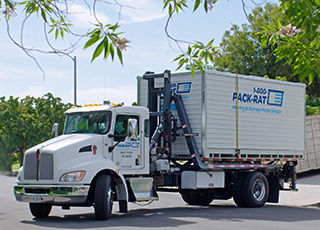
1-800-Pack Rat stands out as a solid moving company choice for military members due to its tailored solutions. Military life often involves frequent relocations and uncertain timelines. With the flexibility this company provides, you won’t feel rushed during your move. This is crucial, especially when you’re juggling various responsibilities.
Moreover, their convenient storage options align perfectly with military deployments or temporary duty assignments. Having a reliable storage solution can save you from the hassle of arranging alternative storage during sudden moves.
PODS is one of the best moving companies for veterans and active-duty military members. They offer a unique approach to moving that can be particularly beneficial for military families, and their portable storage containers give you the flexibility to load and unload your belongings at your own pace.
U-Pack offers a unique pricing structure that can be especially attractive for military families looking to manage their budgets effectively. With U-Pack, you pay based on the space you use in the moving trailer or container, which can lead to significant savings.
They also offer military discounts, demonstrating their commitment to serving those who serve the nation. While the loading and unloading time might be more restricted compared to other options, their cost-effectiveness and convenience can offset this limitation.
5. SMARTBOX
Pros
Portable storage solutions for convenience
Flexible delivery and pickup options
Suitable for both local and long-distance moves
Transparent pricing with no hidden fees
Cons
Limited availability in certain areas
Customer service response time may vary
SMARTBOX offers portable storage solutions that can be particularly appealing to military families dealing with frequent relocations. The flexibility to load and unload your belongings at your own pace can alleviate some of the stress associated with moving.
The transparent pricing structure, with no hidden fees, ensures you know exactly what you’re paying for. However, their availability might be limited in certain regions, and the responsiveness of their customer service could vary.
Moving Companies For the Military: FAQs
Can my DLA rate help cover some costs associated with moving?
Depending on if you have a local or long-distance move, most moving companies for military personnel can take one day for local moves and several days for long-distance moves. International moves can take weeks.
A military relocation professional can help you find a moving company that will relocate you in a sufficient amount of time and also find the best housing solution to meet your needs.
Are there moving assistance programs available to veterans?
Relocating as a military family comes with its challenges, but choosing the right moving company can significantly alleviate the stress associated with these transitions.
From specialized military relocation services to flexible pricing options and convenient storage solutions, these moving companies for the military have proven their ability to cater to the unique needs of military life.