If you’re in the market for a new home, you’re probably looking for ways to save money on your purchase. One way to do this is through rebate programs offered by lenders like Navy Federal Credit Union.
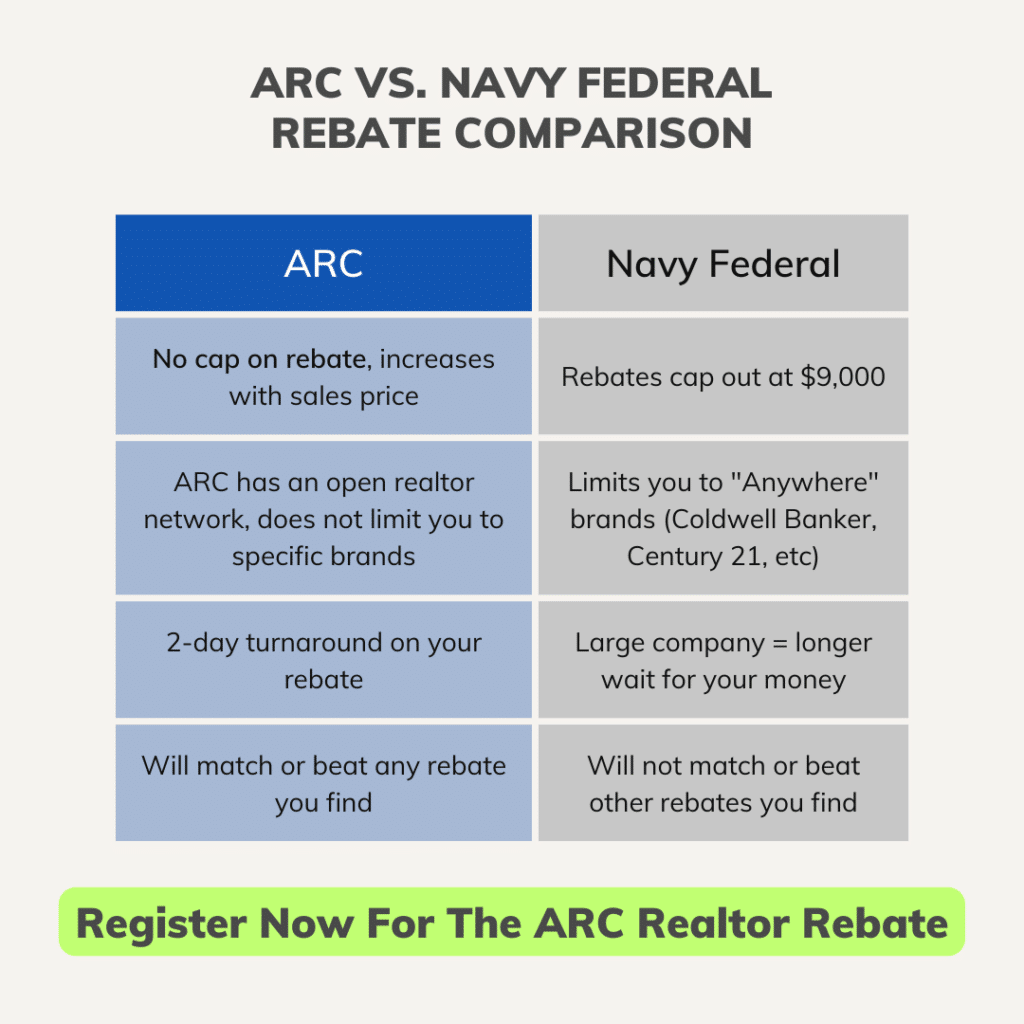
The goal of this article is to compare the Navy Federal Realty Plus Program to the ARC Realtor Rebate program to help you understand which is the better option for you. This chart below breaks down the benefits of the ARC Realtor Rebate Program compared to the Navy Fed program.
Generally, rebates range from a few hundred dollars to several thousand dollars. ARC and your real estate agent can help you determine the exact amount of your rebate.
Benefits of the ARC Realtor Rebate Program vs. Navy Federal
The ARC Realtor Rebate Program is a rebate program offered to help reduce the cost of buying a home. The program provides a rebate to members who use a real estate agent or broker affiliated with the network to purchase or sell a home.
Quick and Easy Sign Up, Fast Turnarounds
Find an affiliated agent: Once you’ve confirmed your eligibility, you’ll need to find an agent or broker who’s affiliated with the program. We have a huge network of realtors.
Work with the agent: Once you’ve chosen an agent, you’ll work with them to buy or sell your home.
Close on your home: Once you’ve closed on your home, you’ll need to submit a rebate request form to receive your rebate.
Receive your rebate: After you’ve submitted your rebate request form, you’ll receive your rebate in the form of a check or direct deposit in as little as two days.
Understanding the Navy Federal Realty Plus Program
The Navy Federal Realty Plus Program is a rebate program offered by Navy Federal Credit Union.
The program provides a rebate to members who use a real estate agent affiliated with Navy Federal Realty Plus to purchase or sell a home. The rebate amount varies, but can range from hundreds to thousands of dollars.
How to Sign Up for the Navy Federal Realty Plus Program
Become a Navy Federal Credit Union member: To be eligible for the program, you need to be a member of Navy Federal Credit Union. You can apply for membership on their website if you’re not already a member.
Find an affiliated agent: Once you’ve become a Navy Federal Credit Union member, you’ll need to find a real estate agent who’s affiliated with the Navy Federal Realty Plus Program. You can find a list of affiliated agents who are military relocation professionals on their website.
Work with the agent: Once you’ve chosen an agent, you’ll work with them to buy or sell your home.
Close on your home: Once you’ve closed on your home, you’ll need to submit a rebate request form to receive your rebate.
Receive your rebate: After you’ve submitted your rebate request form, you’ll receive your rebate in the form of a check or direct deposit.
Rebates for the Navy Federal Realty Plus Program
The amount of the rebate you receive through the Navy Federal Realty Plus Program varies depending on the purchase or sale price of the home. For example, if you purchase a home for $300,000, you could receive a rebate of $1,500. If you purchase a home for $500,000, you could receive a rebate of $3,000.
ARC Realtor Rebate Program vs the Navy Federal Realty Plus Program
So, how do the ARC Realtor Rebate Program and the Navy Federal Realty Plus Program stack up against each other?
Pros of the Navy Federal Realty Plus Program
Easy eligibility: To be eligible for the program, you only need to be a member of Navy Federal Credit Union.
Wide range of properties: The program’s affiliated agents have access to a wide range of properties, including foreclosures and short sales. This means that you can find a home that meets your needs and budget.
Professional guidance: By working with an affiliated agent, you’ll receive professional guidance and advice throughout the home buying or selling process.
Cons of the Navy Federal Realty Plus Program
Limited eligibility: The program is only available to members of Navy Federal Credit Union.
Limited agent options: The program only works with a specific group of real estate agents who are affiliated with Navy Federal Credit Union.
Limited geographical coverage: The program is only available in certain areas.
Pros of the ARC Realtor Rebate Program
No credit union or bank membership required: Unlike other rebate programs, the ARC Rebate Program is open to members of any credit union or bank.
Higher rebates: Depending on the purchase or sale price of the home, you could receive hundreds or even thousands of dollars in rebates through the program. There is no cap on our rebates.
Wide range of properties: The program’s affiliated agents have access to a wide range of properties, including foreclosures and short sales.
Faster Turnarounds: We’re a smaller company so we’re able to get your rebate paid to you in as little as two days.
Cons of the ARC Realtor Rebate Program
Not designed specifically for service members, veterans of any branch of the armed forces, or Department of Defense employees but for anybody looking to buy or sell a home.
Conclusion
The ARC Realtor Rebate Program offers wide eligibility, as it’s open to any credit union or bank members. This can give you more options for finding the right home or buyer. It can be a valuable tool for anyone who is looking to save money on their home purchase or sale.
If you’re planning to buy or sell a home, the ARC Realtor Rebate is a great way to save money on the process. We offer higher rebates, a larger network, and a faster turnaround. Register today to get started!
Planning to relocate your business to Texas? You are not alone. In the past few years, the number of tech companies moving to Texas is on the rise. In fact, this has given rise to a Texas vs Silicon Valley debate.
There’s no doubt that Texas has a welcoming environment for businesses. Moreover, it has been frequently named among the best states for business in America. Still, there are a few more reasons behind the top companies moving to Texas.
After taking a closer look at the issue, we will discuss the main reasons behind the rising popularity of Texas in this article.
Which Companies are Actually Relocating to Texas?
Consider this. Even during the pandemic, around 150 companies have outlined their plans of relocating or expanding to Texas. Here’s a quick rundown on some of the bigger players:
In 2020, Oracle relocated its corporate headquarters from Redwood City to Austin. The company announced that it is a part of their policy of offering flexible employee work locations.
Apple will set up its second-largest campus in the same place.
Elon Musk is moving Tesla’s headquarters to Texas. Tesla is setting up a Gigafactory with over 7.9-million-square-foot space that will employ around 5000 people.
Hewlett Packard Enterprise is moving its HQ to Houston from Silicon Valley. The new campus should be complete in 2022.
Amazon has already chosen Houston as one of its prime hubs a few years back.
Other tech companies moving to Dallas include the infrastructure consulting firm AECOM and the CBRE Group.
Greentown Labs has opened the first “climatetech” startup incubator in Houston which is its second location after Massachusetts.
What Makes Texas a Favorite Choice of CEOs?
A recent survey has revealed that there are three main factors that are considered while choosing a spot as a headquarter. These are tax policy, regulatory climate, and talent availability.
It goes without saying, Texas is a favorable destination from all three aspects. In comparison, California has high tax rates, high housing costs, and strict regulations for businesses that have made it challenging to live and do business in the area.
Moreover, as per the data from the U.S. Census, the population flowfromCalifornia to Texas is on the rise for the past few years.
The Tax Scenario in Texas
Obviously, lower tax brackets will be more attractive to any business. Business taxes in Texas are on the lower side and there is no personal income tax. Besides, the state is also one of the best when it comes to offering incentives to businesses.
At present, the combined state and federal corporate tax rate in Texas stands at 21%- the lowest in the U.S. So compared to the high tax rates in California, Texas is definitely a more attractive choice for businesses.
Texas also has a pro-business environment that is favorable for smaller and younger businesses. The tax on businesses or franchise tax is just 0.375% for businesses with annual receipts between $1.18 million to $10 million. If your receipts are lower than $1.18 million there is no need to pay any franchise tax.
Low Housing Prices In Texas
In general, Texas is considered as a more affordable place for living than the coastal belt. The most populated belt for living in Texas is the area around Houston, Dallas-Fort Worth, Austin, and San Antonio. This is also called the “Texas Triangle”.
In fact, Dallas is one of the best cities to move to in the U.S. The cost of housing in most of these cities remains within a reasonable range.
Apart from that, Texas also offers a low cost of living and lower utilities and transport costs. In addition, the entire process of land acquisition and getting a building permit is extremely efficient. The corporate rent figures in Texas are also lower than those in other top cities.
A recent survey after the pandemic has pointed out that a segment of the employees will prefer to work from home permanently. Moreover, some of them would like to move to locations with a low cost of living index. That makes a location like Austin a good choice for any business.
Texas also has the advantage of being located in the center of the country. This also saves travel time and costs for the relocation of corporate employees.
Availability of Tech Talent
The rich talent pool is another reason for companies moving to Texas. In recent years it has also evolved as an innovation epicenter. While there are some existing skill gaps in the talent levels, the talent costs are lower than those in Silicon Valley.
With the rise in the number of tech companies moving to the state, the rate of domestic migration is also increasing. This is resulting in the rise in the number of skilled workers across a variety of industries.
Note, the state also has a number of higher education institutions. This allows the constant infusion of fresh graduates from the streams of technology, engineering, and services into the workforce.
Biggest Industries and Labor Sectors in Texas
Texas remains the second biggest economy in the U.S., just behind California. It also has the best growth prospects among all the states. At present, it is the ninth-largest economy in the world.
After the effects of the pandemic, the economy of Texas has bounced back in the first quarter of 2021. The higher rate of growth has also resulted in an overall employment gain of 4.7 percent. The forecast for income and employment growth is also strong for the coming five years.
The prime driver of the economy is the energy sector. However, as a result of multiple companies moving to Texas and high expansion rates, other sectors including information technology are making a major impact. It remains the number one state in the U.S. in terms of technology exports.
With the rise in growth rate, the construction industry is another fast-growing sector. While the year 2020 saw a steep drop in construction work, 2021 has seen a slow recovery of the same. The demand for residential real estate is also high at present.
Beyond that, the transportation sector is also a major driver of the economy. As per the planning of the Texas Department of Transportation, the state will need around $21 billion annual funding for developing the various transportation modes.
Last but not the least, leisure and hospitality have emerged as one of the major players in propelling the economic growth of Texas. In August 2020, the industry employed 1.147 million people, especially in food and drinking establishments. This is a figure that is higher than the rest of the country.
Conclusion
These are the main factors that have made Texas a worthwhile destination for companies. As more companies discover the benefits of moving to Texas, the rate of corporate relocations is bound to rise in the coming years.
As with every other area that witnesses rapid growth, there are some challenges of moving to a new statethat are important to consider. That is why you need to seek professional help for developing a hassle-free relocation strategy for shifting your company to Texas.
As an independent relocation management company, we can help you with your relocation to Texas from every aspect. Our expertise, experience, and top-notch customer service can help in ensuring a smooth relocation from all aspects.
If you want to buy or sell a home, you may have heard of the Berkshire Hathaway PenFed Realty Program and the ARC Realtor Rebate Program.
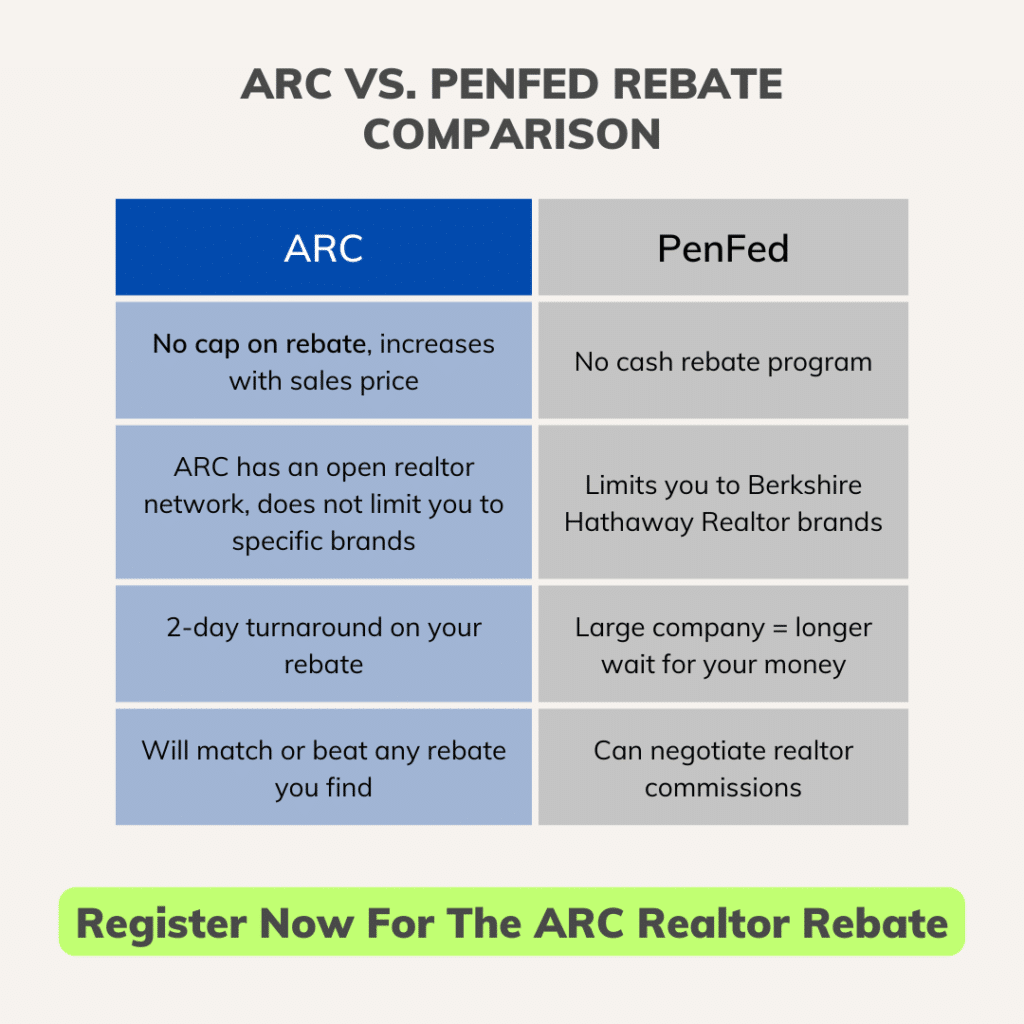
Both of these programs benefit homebuyers but the ARC Realtor Rebate offers more money, faster turnarounds, and a larger real estate network for you to choose from. Check out the chart below to learn more.
The ARC Realtor Rebate Program offers home buyers and sellers a cash rebate. The rebate is a percentage of the home’s sale price and is paid directly to the client after closing. ARC’s program is designed to help offset some of the costs associated with moving, including selling a current home and purchasing a new one.
Higher Rebates vs PenFed Realty
The rebate amount varies depending on the home’s sale price. Generally, the rebates can range from hundreds of dollars to thousands of dollars. Keep in mind that we’ll match any rebate you get from another company so this chart is just a benchmark to give you an idea.
To be eligible for the ARC Rebate Program, you must work with a real estate agent affiliated with the ARC Relocation network. They will guide you through buying or selling a home and work with ARC to help you get the rebate. Above and beyond that, however, It is easy to sign up for the ARC Rebate Program, by submitting some very basic contact information.
Understanding the Berkshire Hathaway Homeservices Penfed Realty Program
The PenFed Realty Program is a real estate brokerage firm that offers services to buyers and sellers. It is part of the Berkshire Hathaway HomeServices network, one of the world’s largest real estate brokerage networks.
PenFed Realty offers many services, including home buying and selling, mortgage services, and property management. They also provide a network of experienced agents who can help clients with all aspects of the real estate transaction.
How to Sign Up for the PenFed Realty Program
To sign up for the PenFed Realty Program, visit their website. Fill out the form with your contact information, and a PenFed Realty representative will contact you to discuss your options.
Rebates for the PenFed Realty Program
The PenFed Realty Program does not offer cash rebates to clients. Instead, they offer competitive commission rates to their agents, which can help clients save money on their real estate transactions.
ARC Realtor Rebate Program vs PenFed Realty Program
The ARC Realtor Rebate Program and the PenFed Realty Program offer different benefits to clients.
The program offers a cash rebate to home buyers and sellers, whether for work relocation, military relocation, or moving for personal reasons. The PenFed Realty Program provides competitive commission rates to their agents.
Cons of the PenFed Realty Program
They do not offer rebates to clients
Limit you to Berkshire Hathaway brands
Longer turnaround times
Pros of the ARC Realtor Rebate Program
Cash rebates with no cap, rebate increases as sale price increases
Faster turnarounds in as little as two days
We’ll match any rebate
ARC has an open realtor network which increases your options
Available in all 50 states
Conclusion
Both the ARC Realtor Rebate Program and the PenFed Realty Program benefit clients and agents alike. The ARC Realtor Rebate Program provides a cash rebate to clients, while the PenFed Realty Program offers its agents a wide range of services, they don’t offer rebates.
Clients should consider their individual needs and preferences when choosing between these programs. With generous cash rebate amounts, the ARC Rebate Program is an excellent choice for anyone buying or selling a home or relocating for work looking to save money.
The core flex model is one of the most talked-about and most debated approaches in employee relocation. A core flex relocation policy pairs a fixed core benefit that every eligible transferee receives with a menu of flexible, optional benefits each employee can choose from based on their situation. It gives people some control over their move while keeping the company in control of the budget. That balance is why the model has caught on. It lets HR and recruiting teams offer real choice without writing a blank check, and it moves away from the one-size-fits-all package that either overspends on employees who don’t need much or underserves the ones who need more. Done thoughtfully, a core flex relocation program works for employees, hiring managers, and finance at the same time.
What Is the Core Flex Relocation Model?
A core flex model has two parts.
The core is the base relocation package available to everyone in a given tier. It covers the essentials of getting a person moved. The flex is a set of optional, a la carte benefits employees select from to round out their package based on family size, homeowner or renter status, distance, and personal needs.
Think of it as a hybrid: more structure than a pure lump sum relocation, more flexibility than a rigid tiered policy.
What goes in the “core”
Core benefits are the services almost every move requires. A typical core relocation benefit includes:
Relocation counseling from a dedicated relocation consultant who guides the transferee through the whole process
The rule of thumb: the core should cover what a person genuinely needs to complete the move. The flex should sweeten the deal and handle individual circumstances, not hide an essential like packing or transport behind an optional choice.
Why the Core Flex Model Is Gaining Ground
Relocation looks different than it did a decade ago, and the core flex model is a direct response to that shift.
The first driver is the competition for talent. Recruiters and hiring managers need every tool available to sign the right person, and mobility benefits that feel personalized make a relocation offer more attractive. The second is a workforce that expects choice. Younger and millennial transferees are used to customizing nearly everything in their lives and tend to be skeptical of corporate mandates and one-size-fits-all solutions. A package that recognizes their specific circumstances lands better and lifts acceptance rates.
There’s a cost angle too. A single flat package almost guarantees you’re either paying for benefits some employees never use or coming up short for those with bigger needs. By aligning benefits to the person while capping flexible spending, a core flex relocation policy controls cost and reduces the expensive one-off exceptions that quietly break a relocation budget.
Core flex is essentially an evolution of the tiered model. It keeps the cost segmentation of tiers by job level, salary, and homeowner or renter status, then layers in personalization so the company minimizes costly exceptions without alienating talent.
Core Flex vs. Other Relocation Policy Types
Policy type
How it works
Best for
Trade-off
Lump sum
One cash amount the employee spends however they want
Experienced movers, executive relocation
High risk of mismanagement by inexperienced movers
Tiered
Fixed benefits assigned by job level or salary band
Large, predictable programs
Rigid; misses individual needs and invites exceptions
Fully managed
The company or RMC directs the entire move
Complex or international moves
Least employee choice
Core flex Balanced
A fixed core benefit plus a menu of optional, employee-selected benefits
Mixed workforces that want choice and cost control
More administration to manage
Advantages of the Core Flex Model
Cost savings. Picture relocating two people in the same role: one is single, the other has a spouse and three kids. A flat package pays them both the same when their real costs are nowhere near equal. Core flex lets the employee with more need elect the extra benefits while the company avoids overpaying everyone else. You can read more on what drives employee relocation costs and where the money actually goes.
More flexibility, fewer disputes. When each employee chooses the benefits that fit their situation, fewer of them come back to renegotiate or ask for a one-off exception. That reduces friction for HR and keeps moves on schedule.
A stronger recruiting tool. A mobile, choice-driven workforce responds to a package that feels built for them. Offering core flex signals that your company understands individual circumstances, which helps attract and retain the talent you’re competing for.
Disadvantages of the Core Flex Model
The model isn’t automatic, and it’s worth being honest about the downsides.
More administration. Building a package tailored to each person creates more paperwork, tracking, and oversight than a simple relocation bonus or reimbursement. Every transferee’s benefits, finances, and approvals have to be managed case by case.
Equity and morale risk. When employees compare packages and discover a colleague received something they didn’t, resentment can follow, along with pressure to renegotiate benefits that weren’t on offer. Clear, consistent rules about who’s eligible for what are essential to keep the program fair.
How to Build a Core Flex Policy: Four Approaches
There are several ways to structure the flex side so it stays simple for employees and managers. These are the most common employee-driven models.
Menu approach
Employees get a list of optional benefits and choose a set number based on factors like dependents, marital status, and position. This works best when the menu items cost roughly the same and each one is a genuine perk rather than a necessity. Nothing an employee actually needs to complete the move (a moving truck, packing) should sit in the optional menu.
Monetary cap approach
Also called a dollar-value cap. Instead of naming specific benefits, you provide a set dollar amount on top of the core for the employee to spend on flex options, with the cap varying by position, dependents, or marital status. It works well when the cap is calculated from real relocation costs. The catch is that it puts budgeting pressure on the employee, and someone with no relocation experience can find that stressful.
Points-based approach
Each flex benefit is assigned a point value, and employees receive a set number of points based on their circumstances. Functionally it’s the cap approach without dollar signs in play, which can feel less transactional. It takes real diligence and experience to assign values correctly, so many companies run it with the help of an experienced relocation management company.
Lump sum approach
A single sum is provided for flex benefits, calculated from historical relocation costs, and the employee spends it as they see fit with no company intervention. It’s popular but carries risk: an inexperienced mover may mismanage the money or the timeline. It shines in executive relocation, where a seasoned transferee benefits from being in the driver’s seat.
Best Practices for Implementing Core Flex
A successful rollout comes down to a few fundamentals. Communicate the policy clearly so employees understand what’s core, what’s flex, and how to choose. Benchmark your benefits against your industry and peers so the package stays competitive; ARC’s relocation policy benchmarking resources are built for exactly this. Set consistent eligibility rules to protect equity. And review the program regularly with your business units to confirm it’s still doing what you designed it to do.
How ARC Helps You Build a Core Flex Program
At ARC Relocation, we’ve helped many companies design and run a successful core flex model. As a full-service relocation management company, we handle the counseling, vendor coordination, expense tracking, and compliance so your internal team isn’t managing every move by hand. It starts with clear communication and careful planning, then follow-up with individual business units to keep everything running smoothly, whether the moves are domestic or international.
Core Flex Model: Frequently Asked Questions
What is the core flex model in employee relocation?
It’s a relocation policy that combines a fixed core benefit every eligible employee receives with a menu of flexible, optional benefits they choose based on their needs. It balances employee choice with company cost control.
What’s the difference between core flex and a lump sum relocation?
A lump sum gives the employee one cash amount to spend however they want, with no guardrails. Core flex still provides managed core services and only applies choice to the flex portion, which reduces the risk of an inexperienced mover mismanaging the money.
What benefits belong in the core versus the flex?
The core covers essentials most moves require: counseling, home-sale help, temporary housing, travel, and household goods shipment. The flex covers situational add-ons like home purchase assistance, spousal career support, storage, mortgage help, child or elder care, and a miscellaneous allowance.
Is a core flex model cheaper than a standard relocation package?
It often is, because you stop paying for benefits employees don’t use and cap spending on the ones they do. Actual savings depend on your workforce mix and how the caps are set. Our relocation cost calculator can help you estimate.
Who is the core flex model best for?
Companies with a mixed workforce, employees at different life stages, family situations, and homeowner or renter status, who want to offer real choice while keeping costs predictable.
How is core flex different from a tiered relocation policy?
A tiered policy assigns fixed benefits by job level or salary. Core flex keeps that segmentation but adds personalization within each tier, which cuts down on the costly exceptions rigid tiers tend to generate.
Ready to Build Your Core Flex Model?
If you’re planning a corporate relocation and think the core flex model might fit, you don’t have to design it alone. ARC helps companies benchmark, build, and manage core flex relocation programs that give employees choice and keep your budget in check.
DITY Move Calculator: Estimate Your Military Move Reimbursement
Starting in January of 2021, the military decided to increase the reimbursement amount for moving expenses from 95 to 100 percent. This means that the government will pay 100 percent of your expenses in the event of a PCS.
For those who are organized and great at managing money, you can go through the entire move and actually end up with money left over on the other side.
A PPM calculator can help you do this by helping to calculate the total expenses of your move while factoring in your reimbursements or allowances.
Our DITY move calculator will provide you with estimates for all branches including: Navy, Army, Marines, Air Force, Coast Guard, and Space Force.
Updated with 2026 DoD rates
DITY / PPM Move Calculator
Estimate what you could pocket on a Personally Procured Move — the incentive payment plus your DLA, mileage, and per diem allowances.
Age 12+ (include spouse)
Under 12
With-dependent rates applied.
Use the official DTOD distance from your orders when you have it.
Your weight allowance: —. Reimbursement is capped at this weight.
MALT is paid per authorized vehicle, regardless of passengers.
Auto-calculated from distance.
Everything you’ll actually spend to move yourself. Keep every receipt.
Auto-estimated from your weight and distance. The exact figure comes from your TMO / move.mil counselor — drop it in here for a precise result.
This tool provides estimates only using published 2026 DoD rates (DLA per DTMO MAP 72-25(I), MALT $0.205/mile, standard CONUS per diem, JTR weight allowances). The PPM incentive is an approximation of the Government Constructed Cost; your actual payment, entitlements, and tax treatment depend on your orders, official DTOD distance, and finance-office approval. Verify everything at move.mil and travel.dod.mil. ARC Relocation is a private third-party company, not a government or military entity.
Now make your move pay off
Two smart moves once you know your numbers
Find movers the smart way
Doing a PPM or hiring out part of it? Skip the phone tag. Agoyu is a free AI app that pulls fast, accurate quotes from local movers so you can compare and book in minutes.
Put thousands back in your pocket at closing with our military realtor rebate program. It’s cash back on the home you’re already buying or selling for your move.
A personally procured move has a lot of moving parts, but the math behind it is simple once you know your numbers. Fill in the fields with the details from your PCS orders and your own move plan, and the calculator handles the rest. It updates as you type, so you can adjust any figure and watch your estimate change right away.
Step 1: Enter your move details
Pay grade. Pick your grade from the list. This sets two things at once: your Dislocation Allowance and your household goods weight allowance. Prior-enlisted officers have their own entries (O-1E, O-2E, O-3E), so use those if they apply to you.
Dependents moving with you. Enter how many dependents are relocating, split by age, and count your spouse as a dependent age 12 or older. Having dependents on your orders moves you to the higher DLA and weight allowance, and each traveler adds to your per diem.
Distance to your new duty station. Enter the mileage between your old and new bases. Once you have your orders, use the official DTOD distance instead of a figure from a maps app, since that's the number finance pays on. This drives your mileage reimbursement, your travel days, and your government payment estimate.
Estimated weight you'll move. Enter how many pounds of household goods you plan to move yourself. The calculator shows your weight allowance right below the field and caps your reimbursement there, so anything over that limit won't add to your payment. A quick way to estimate: figure about 1,500 pounds per furnished room, then add the weight of your large appliances.
Vehicles you'll drive. Choose how many vehicles you're driving to the new station. Mileage is paid per authorized vehicle, so two cars earn more than one. Pick "none" if you're flying.
Authorized travel days. The calculator fills this in for you based on distance, using the standard rule of one day for the first 400 miles and one more for each additional 350. If your orders authorize a different number, type it in. The "reset to auto" link puts the calculated figure back.
Your estimated moving costs. Enter everything you expect to spend to move yourself: truck or trailer rental, fuel, packing supplies, moving help, tolls, and lodging on the road. This is the number that decides how much of your government payment you actually keep, so be realistic and save every receipt.
Estimated government payment (GCC). The calculator estimates this for you from your weight and distance. If your transportation office or move.mil counselor has already given you an official figure, type it in for a sharper result. The "reset to auto" link returns to the estimate.
Step 2: Read your results
The large number at the top is your estimated money in your pocket. It combines two very different kinds of money, and the breakdown below it keeps them separate on purpose.
The PPM incentive is your profit for moving yourself. It starts with the government payment, subtracts what you spend on the move, then subtracts roughly 22 percent for taxes, since this profit counts as taxable income. What's left is yours.
The allowances are the DLA, mileage, and per diem you receive no matter how you move. These are non-taxable, and you collect them whether you do a PPM or let the government ship your goods. That's why they sit in their own section rather than getting mixed in with your profit.
Updated with 2026 DoD rates
DITY / PPM Move Calculator
Estimate what you could pocket on a Personally Procured Move — the incentive payment plus your DLA, mileage, and per diem allowances.
Age 12+ (include spouse)
Under 12
With-dependent rates applied.
Use the official DTOD distance from your orders when you have it.
Your weight allowance: —. Reimbursement is capped at this weight.
MALT is paid per authorized vehicle, regardless of passengers.
Auto-calculated from distance.
Everything you'll actually spend to move yourself. Keep every receipt.
Auto-estimated from your weight and distance. The exact figure comes from your TMO / move.mil counselor — drop it in here for a precise result.
This tool provides estimates only using published 2026 DoD rates (DLA per DTMO MAP 72-25(I), MALT $0.205/mile, standard CONUS per diem, JTR weight allowances). The PPM incentive is an approximation of the Government Constructed Cost; your actual payment, entitlements, and tax treatment depend on your orders, official DTOD distance, and finance-office approval. Verify everything at move.mil and travel.dod.mil. ARC Relocation is a private third-party company, not a government or military entity.
Now make your move pay off
Two smart moves once you know your numbers
Find movers the smart way
Doing a PPM or hiring out part of it? Skip the phone tag. Agoyu is a free AI app that pulls fast, accurate quotes from local movers so you can compare and book in minutes.
Put thousands back in your pocket at closing with our military realtor rebate program. It's cash back on the home you're already buying or selling for your move.
It comes down to three things: your weight allowance, the distance of your move, and how cheaply you can move yourself. Most service members clear somewhere between $2,000 and $8,000 in profit, and long, heavy moves done on a tight budget can run higher. The calculator above gives you a number for your own situation, but the pattern always holds. The more weight you move under your allowance, and the less you spend doing it, the more you keep.
Is my PPM profit taxable?
Yes. Whatever is left of your government payment after your documented moving costs counts as taxable income, and finance withholds a flat 22 percent when they pay you. That withholding comes off the full payment up front, which is why keeping every receipt matters. Active-duty members can still deduct unreimbursed PCS moving costs at tax time on IRS Form 3903, which lowers your taxable profit and often returns part of that withholding as a refund. Your DLA, mileage, and per diem are separate from all of this and stay non-taxable.
What happens if I move more than my weight allowance?
On a PPM, the government pays you only up to your authorized weight, so any pounds over that limit earn nothing extra. The upside is that you won't be billed for the overage the way you would on a government-arranged move, where excess weight becomes a debt. Weigh your loaded and empty vehicle at a certified scale and keep the tickets, since your entire payment is built on that certified weight.
Can I do a partial PPM instead of moving everything myself?
Yes, and plenty of families choose this route. You can let the government ship your heavy furniture and appliances while you personally move the lighter, higher-value items like electronics, tools, and important documents. You still get paid for the portion you move yourself, so it's a lower-effort way to earn part of the profit without loading a 26-foot truck across the country.
Do I get paid before the move or only after?
You can request an advance of up to 60 percent of your estimated payment through your transportation office once your orders are approved. That advance helps cover the truck, fuel, and supplies so you're not fronting the whole move out of your own pocket. The remaining balance is paid after you turn in your completed paperwork and weight tickets at your new duty station.
What paperwork do I need to get reimbursed?
Start with approval from your transportation office before you move a single box, because a PPM without pre-approval usually can't be paid. After that you'll need your PCS orders, certified empty and full weight tickets for each trip, receipts for your moving costs, and your completed travel voucher. File everything promptly once you report in, and keep copies for tax season so you can claim your expenses later.
Household goods shipping is the packing, transit, customs clearance, and delivery of an employee’s personal property as part of a corporate relocation. ARC coordinates household goods shipments across the US and into more than 85 countries through a vetted global carrier network, using proprietary technology to compare mover rates and service quality before each booking. Domestic moves typically take 1 to 14 days, international sea freight runs 4 to 10 weeks depending on destination, and the average corporate household goods shipment costs $5,000 to $15,000 domestically and $10,000 to $30,000+ internationally.
What it covers: packing, loading, freight transit, customs clearance, delivery, and unpacking
Domestic vs international: domestic moves are days; international moves are weeks-to-months with customs and documentation requirements
Cost drivers: distance, household size, shipping method (sea, air, land), and destination country
ARC’s role: program coordination, carrier selection, documentation oversight, and a single point of contact for HR and the employee
Federal experience: ARC runs ~1,600 international household goods shipments annually for US Customs Agent placements worldwide
What Is Household Goods Shipping?
Household goods shipping is the transportation of an employee’s personal belongings from one home to another as part of a relocation. The work covers packing the home, loading the truck or container, transit by sea/air/road, customs documentation and clearance for international moves, delivery at destination, and unpacking.
For a corporate relocation, household goods shipping is one of the most visible and expensive line items in the program. Done well, the employee shows up at their new home with their belongings intact and on time. Done poorly, the shipment sits in a port for three weeks accruing storage fees while the employee buys replacement clothes and dishes on the company card.
ARC’s role on the household goods side is coordination, not direct transport. We select carriers from a vetted global network, manage the documentation and customs work, oversee the move from origin survey through final delivery, and provide a single point of contact so HR and the employee aren’t chasing the moving company directly.
Domestic vs. International Household Goods Shipping
These are genuinely different products and need to be planned differently.
Domestic shipping moves within a single country, typically by road for moves under 1,500 miles and by a combination of road and rail for longer distances. Timelines run 1 to 14 days. Documentation is straightforward (inventory, bill of lading, insurance certificate). Costs are driven by distance, household size, and accessorial services like specialty packing.
International shipping crosses borders and adds layers of complexity that don’t exist domestically. Customs documentation has to be precise. Restricted items vary by country. Transit times stretch from weeks to months depending on destination and shipping method. Costs are higher and have more variables — base freight, terminal handling, customs duties (sometimes), destination delivery, demurrage if anything sits too long. Insurance and valuation rules change between countries.
Most corporate relocation programs handle both. The skill is knowing which shipping method, container size, and carrier fits each specific move, because the wrong choice on an international move can mean weeks of delays the employer ends up paying for.
Work With an ARC Household Goods Shipping Counselor
Shipping Methods: Sea, Air, and Land
Three transport modes cover essentially every household goods shipment, and the choice depends on distance, urgency, budget, and destination.
Sea freight is the standard for international household goods. Transit times run 4 to 6 weeks door-to-door from the US to Europe, 6 to 10 weeks to Asia and Australia, and longer for emerging market destinations. Sea is the most cost-effective method for full household shipments and accommodates the largest volumes. Two container options exist: full container load (FCL) for whole-home shipments and less-than-container load (LCL) for partial shipments that share container space with other shipments.
Air freight moves household goods in 3 to 10 days but costs three to five times more than sea freight for the same volume. Most corporate policies use air freight for a small “essentials” shipment (clothing, work materials, kids’ items) that arrives in week one while the full sea freight shipment is in transit. Full air shipments are rare and usually reserved for emergency relocations or short-term assignments.
Land freight covers domestic moves and cross-border road transport (US to Canada, US to Mexico, intra-EU). Transit times depend on distance, with US cross-country moves typically taking 7 to 14 days. Land freight is the dominant mode for domestic moves and the only option for landlocked destinations served by road.
Most international moves combine modes — an air shipment for immediate needs and a sea shipment for the bulk of the household. The split adds coordination work but gets the family functional faster.
Get Tips for Choosing a Household Goods Mover
Container Sizes and What They Hold
International household goods shipments are priced and planned around container space.
20-foot container (FCL). Roughly 1,150 cubic feet of usable space. Fits the contents of a 1 to 2 bedroom apartment or small family home. Common for single executives, couples, or families willing to ship less.
40-foot container (FCL). Roughly 2,400 cubic feet. Fits a 3 to 4 bedroom home. The standard for family relocations with full household contents.
40-foot high-cube container. Same footprint as the 40-foot but with an extra foot of height (roughly 2,700 cubic feet). Useful for tall furniture or larger households.
LCL (less-than-container-load). Shipment shares space with other shipments in a consolidated container. Priced by cubic meter or cubic foot. Best for partial shipments under 500 cubic feet, though transit times run 1 to 2 weeks longer than FCL because of consolidation and deconsolidation at both ends.
The origin survey is where the container call gets made. A move coordinator visits the home, inventories the household, and recommends the appropriate container based on volume and destination. Getting this right matters because under-sizing forces leaving items behind and over-sizing pays for empty space.
The Household Goods Shipping Process
A standard international household goods shipment runs through eight stages from kickoff to delivery.
Stage 1: Pre-move survey. A move coordinator visits the home to inventory contents, identify special items (pianos, art, vehicles, antiques), and recommend container size. This usually happens 4 to 8 weeks before the moving date.
Stage 2: Carrier selection and quoting. ARC compares quotes across the carrier network based on the survey, factoring in carrier performance in the destination country, transit time, and cost. The employee and HR review and approve before booking.
Stage 3: Documentation preparation. Customs forms, valuation declarations, packing lists, and any country-specific paperwork get prepared. For international moves, this includes inventory translation when required and any required apostille or legalization.
Stage 4: Packing and loading. A professional packing crew arrives at the home, typically 1 to 2 days before pickup. They wrap, box, and inventory every item, then load the container or truck. For international moves, the container is sealed and the seal number recorded on the bill of lading.
Stage 5: Transit. Sea freight goes to port, loads onto a vessel, and sails. Air freight goes to an airport and ships. Land freight drives. The employee gets tracking information and milestone updates throughout.
Stage 6: Customs clearance. At the destination port or airport, the shipment clears customs. This is where preparation pays off — clean documentation moves through in days, problematic documentation can sit for weeks accruing storage fees.
Stage 7: Destination delivery. The shipment is trucked from the port to the new home. For international moves, a destination agent handles in-country logistics including any required permits for delivery access.
Stage 8: Unpacking and claims. The crew unpacks at destination, removes packing materials, and walks through the inventory with the employee. Any damage claims get filed within the policy window.
Total time from packing day to settled-in-new-home runs 1 to 2 weeks domestically and 6 to 14 weeks internationally depending on destination.
How Much Does Household Goods Shipping Cost?
Costs vary by distance, household size, shipping method, and destination, though most corporate moves fall into predictable ranges.
Domestic US household goods shipping:
Local moves (under 100 miles): $1,000 to $5,000
Intrastate (100-500 miles): $2,500 to $8,000
Interstate cross-country: $5,000 to $15,000 for an average 3-bedroom household
Long-distance with full-service packing and storage: $10,000 to $20,000+
International household goods shipping:
20-foot FCL sea freight US to Western Europe: $5,000 to $10,000 base freight
40-foot FCL sea freight US to Western Europe: $8,000 to $15,000 base freight
LCL sea freight US to Europe: $1,500 to $5,000 for partial shipment
Air freight US to Europe: $10,000 to $25,000 for similar volume to a 20-foot container
US to Asia/Australia destinations: 30% to 50% higher than European equivalents
These are base freight numbers. Total cost to the company runs higher once packing, customs handling, destination delivery, marine insurance, and any storage are added. Total international household goods shipping costs for a typical family relocation usually land between $15,000 and $35,000.
You can get a closer estimate using our relocation cost calculator or by talking to our team about your specific destinations and program volume.
How ARC Coordinates Household Goods Shipping
A few things separate ARC’s approach from working directly with a moving company or freight forwarder.
Carrier network and AI-backed comparison. ARC has built a vetted global carrier network and a proprietary technology platform that compares carrier rates, performance data, and customer feedback for each specific origin-destination pair. When a new move comes in, the system surfaces the carriers most likely to deliver on time and on budget for that exact lane, not just the lowest bidder. That data layer is something individual moving companies can’t replicate.
Single point of contact. Your HR team and the transferring employee both work with one ARC counselor who owns the shipment from kickoff to delivery. No coordinating between movers, freight forwarders, customs brokers, and destination agents — the counselor handles that on the back end.
Government experience at scale. ARC runs approximately 1,600 international household goods shipments per year for US Customs Agent placements worldwide, plus shipments for the IRS, State Department, and other federal agencies. That volume and that level of customs compliance scrutiny is something most private movers don’t approach.
Independence and no franchise affiliations. ARC isn’t owned by a van line or moving company, which means we recommend the carrier that fits the move rather than the one we’re obligated to use. Better fit, better outcomes.
Integrated relocation context. Household goods shipping doesn’t happen in isolation — it has to coordinate with visa timing, temporary housing, destination services, and the employee’s start date. ARC manages all of that as one program, so the shipment doesn’t arrive before the new home is ready or sit in storage because the visa got delayed.
Household Goods Shipping FAQs
How much does it cost to ship household goods internationally?
Total international household goods shipping costs for a typical family relocation usually run $15,000 to $35,000, with base freight ranging from $5,000 to $15,000 depending on container size and destination. Asia and Australia destinations cost 30% to 50% more than Western European equivalents.
How long does it take to ship household goods overseas?
Standard sea freight runs 4 to 6 weeks door-to-door from the US to Western Europe and 6 to 10 weeks to Asia and Australia. Air freight cuts transit time to 3 to 10 days at three to five times the cost. Total time from packing day to settled-in-new-home is usually 6 to 14 weeks for international moves.
What’s the difference between FCL and LCL shipping?
FCL (full container load) means the employee’s shipment fills an entire 20-foot or 40-foot container and ships as a sealed unit. LCL (less-than-container-load) shares container space with other shipments and is priced by cubic measurement. LCL is cheaper for small shipments but adds 1 to 2 weeks to transit because of consolidation handling at both ends.
Are there items that can’t be shipped internationally?
Yes, restricted and prohibited items vary by destination. Common universal restrictions include hazardous materials, certain food items, plants and seeds, and firearms in many countries. Each destination has specific rules, and ARC’s counselors review the restricted list with each employee before packing.
What insurance is included for household goods shipping?
Corporate relocation programs typically include full value protection coverage that reimburses the actual replacement value of damaged or lost items, subject to a deductible. International shipments add marine insurance covering pickup-to-delivery transit. Coverage levels and deductibles vary, and ARC walks through the specifics during the pre-move survey.
Does ARC handle storage if the employee isn’t ready to receive their shipment?
Yes. Storage-in-transit (SIT) and longer-term storage at origin or destination are standard parts of the household goods shipping program. Most policies cover storage for a defined period, and ARC’s counselor coordinates the timing so the shipment delivers when the new home is ready.
Can ARC handle vehicle shipping with household goods?
Yes, though vehicle shipping usually books separately from household goods because the documentation, customs rules, and carriers are different. For international moves, ARC also walks through whether shipping the vehicle makes financial sense for the specific destination, since compliance modifications in some countries exceed the value of the car.
What happens if items are damaged during shipping?
Damage claims get filed within the policy window after delivery, usually 30 to 60 days depending on the carrier. The ARC counselor walks the employee through the inventory at delivery to identify any damage and supports the claims process from there. Full value protection coverage reimburses at replacement value subject to the deductible.
Office relocation can mean downtime, loss of productivity, potentially disgruntled employees, and plenty of headaches for the HR department. It doesn’t have to be that way though. This is an exciting time for your company but the work involved can quickly turn it into a nightmare.
This is where office moving services come into play. We take the burden off your back so you can focus on the day-to-day operations of running a business and managing your staff.
Reasons to Hire an Office Moving Service
Here are some no-brainer reasons to hire office move services.
Efficient and Stress-Free
The most obvious and simple reason to hire moving office services is because it’s simpler, easy, and more efficient this way. We’re professionals, we do this everyday, and we understand what types of issues or problems you may run into before they happen.
One of the keys to coordinating an effective corporate relocation is anticipating problems ahead of time. This isn’t our first time relocating–We have a long list of problems we’ve run into over the years. We’ve already made the mistakes so you don’t have to worry about making them this time around.
Turnkey Solution
No matter what business activity you’re taking on, planning and organization will determine how well everything goes. To coordinate a successful office relocation project you need a team of trained professionals on your side. Best of all, a good office moving company will provide a turnkey solution which means you won’t have to do any more or less than you want.
You can be involved in the process if you’re the kind of HR manager that likes to have their hands in on everything. Or, you could be like most people and hand it off to an office move company like ARC to handle for you. We do this all the time, we know what needs to be done, we understand how to coordinate everything properly, and we won’t stop until you’re satisfied.
Keeps the Office Running
One of the biggest issues with a large-scale corporate relocation is downtime. When you’re moving people, relocating equipment, setting up infrastructure on the other side, packing stuff, and planning everything it’s easy for employees to get distracted which can lead to unnecessary downtime and lower morale.
Handing the job off to commercial relocation services allows your employees to continue focusing on day-to-day operations and can protect the company from any financial downfall that may result from an extended period of low performance. If you and the whole team can focus on running the business while we focus on coordinating the move, it will make the whole thing run smoother which will result in improved morale.
Saves Money
This is the one point that a lot of companies don’t realize, but hiring office moving services can actually help you save money. Some of the costs you might run into if you do everything alone are:
Moving truck and company costs
Moving and packing materials
Tools and devices for disassembling and transporting furniture
Lost working hours
Think about how quickly these costs can add up. Not to mention the fact that you’re going to make mistakes, there will be bottlenecks, and you’ll be responsible for handling everything yourself.
On the other side of the coin, you can hire a corporate relocation company, we take care of everything, and there’s one flat fee for it all from A to Z. It takes a lot of the guessing out and you don’t have to lift a finger if you don’t want to.
Gets The Equipment You Need
Office relocation project management requires you to think about all the minor details as much as the big ones. One thing that a lot of HR professionals overlook is the tearing down and reassembling of office desks, cubicles, tables, and other office furniture. Chances are, that stuff has been there so long that you neglect to realize it came in a box and was put together years prior.
Office moving companies like ARC have all the contacts and resources necessary to make the process smooth and fast. We’ll make sure it all gets quickly and safely broken down for you, stored neatly in a way that is easy to transport, and even put back together when it gets to your new office. Trying to do this on your own or find office relocation movers that offer it will be difficult and costly.
Banks on Experience
Our experience is the number one reason why people hire us for office moving services. Everyone has their thing and we don’t claim to know everything, but we know how to conduct a smooth and efficient corporate relocation.
Office relocation requires quick planning and the ability to pivot in a seconds notice. You have an office to run, employees to manage, and now – employees to relocate. The last thing you want to think about is the fact that the moving truck is going to be two hours later than planned. Let the experienced team at ARC take care of your cross country or international relocation.
Coordinates Transportation For You
Whether you’re moving five or fifty employees, transportation can be a challenge. You need to do all of this in a way that is timely, affordable, and easy for the employees. Keep in mind that they’re going through a lot as well. They might be uprooting a family, leaving loved ones behind, selling a home, taking kids out of school etc. This is all very stressful for them too.
Not to mention determining the costs of all of these things. Figuring out a relocation package for your employees is one of the most difficult aspects. If you don’t have experience, you’ll have a hard time. We’ll help you compile all of the relocation expenses so you can put together the ideal relocation package for your business.
Let us handle the transportation, airlines, moving companies, storage containers, dumpsters, and all that. You just worry about keeping your staff happy.
We’re Trained, Licensed, and Insured
Last but not least, reputable office moving professionals are insured. Even if you’re operating a small office, the potential for something to go wrong can be very costly. The data and information you have are also very valuable to your operation.
Good news–We work only with licensed, insured, and highly rated professionals, so your critical equipment, furnishings, and information are treated carefully and with respect.
In the event of an accident where something does get broken, you aren’t left without recourse. Professional office moving services have insurance to cover these types of situations so you’re always protected.
What Is the Difference Between Residential and Office Moving Services?
Size of items being moved – Residential moves usually involve furniture, boxes, and household items, while office moves involve desks, chairs, computers, office equipment, files, and other business items. Office items tend to be bulkier and heavier.
Packing services – Residential movers often provide packing services, thoroughly wrapping and protecting items. Office movers may just transport pre-packed items.
Timeframe – Residential moves can sometimes be done in a single day. Office moves often take multiple days or weeks, depending on the size of the office.
Logistics – Office moves require more coordination for disconnecting/reconnecting internet, servers, phone systems etc. Access to elevators, loading docks also needs to be arranged in advance.
Regulation – There are regulations specific to moving offices, regarding transporting sensitive documents, confidential files and equipment. Special care needs to be taken.
Cost – Generally speaking, office moves have a higher cost than residential moves due to the above factors – heavier items, IT requirements, secure document transport, overtime labor charges etc. Storage costs also differ.
In summary, office moves require expert navigating of business and technology systems, security clearances and are more complex overall than the average home moving service.
Get Started
To learn more about ARC office moving services, schedule a free call today. We’ll discuss your options and provide you with a customized quote. We offer a wide-range of services to appeal to businesses of varying sizes and stages of growth
Global mobility services help companies move employees across countries while staying compliant with immigration, tax, payroll, and labor laws. The right program turns relocation from an HR headache into a workforce advantage your company can use to win global talent and open new markets faster.
What they are: end-to-end support for international employee relocations
Who needs them: companies expanding abroad, hiring global talent, or running cross-border assignments
Why outsource: in-house teams rarely have the bandwidth or jurisdiction expertise to handle global moves at scale
What ARC delivers: customized mobility programs, policy consulting, and a single point of contact for every move
What Are Global Mobility Services?
Global mobility services are the planning, logistics, compliance support, and employee assistance a company uses to move workers across borders for business reasons. The term covers everything from a single short-term assignment to a fully managed international relocation program with hundreds of moves per year.
You’ll hear the term used a few ways. Some companies call it talent mobility, others say global workforce mobility, and a few stick with international relocation services. They all describe the same function: getting the right person to the right country with the paperwork, support, and tax structure handled correctly.
Cross-border work creates legal and operational complexity fast. A two-month assignment in Germany can trigger permanent establishment risk. A new hire in Singapore needs a work pass before they can start. A family moving to São Paulo needs schools, housing, and a bank account in place before week one. Global mobility exists so HR teams aren’t trying to solve all of that on their own.
What’s Included in a Global Mobility Program
A full mobility program usually covers six core areas. Each one has its own moving parts, and skipping any of them tends to create problems later.
Immigration and visa support. Every country handles work authorization differently. Your mobility partner should manage visa applications, work permits, residency documentation, and renewals across every jurisdiction you operate in.
Tax and payroll structuring. Cross-border employees raise questions about home-country tax, host-country tax, tax equalization, andshadow payroll. A good program handles all of it before the employee boards a flight.
Household goods shipping. International moves involve customs documentation, transit insurance, port handling, and door-to-door coordination. Mistakes here cause delays measured in weeks, not days.
Destination services. Home finding, school searches, cultural orientation, and area tours help your employee and their family settle in fast. The faster they settle, the sooner they’re productive.
Policy design and benchmarking. Yourrelocation policy sets expectations for what the company pays for, what the employee handles, and how exceptions get approved. Without one, every move becomes a custom negotiation.
Ongoing assignment management. Long-term assignments need check-ins, payroll adjustments, lease renewals, and eventual repatriation support. The work doesn’t stop at touchdown.
Types of Global Mobility Assignments
Not every international move looks the same, and your mobility program should reflect that. Five assignment types cover most situations.
Short-term assignments run from a few weeks up to a year. They’re common for project work, training, or covering temporary gaps. Tax exposure is usually manageable, though anything past six months starts to trigger host-country obligations.
Long-term assignments typically last one to five years. The employee keeps their home-country employment relationship while working abroad, and you’ll need full immigration support, family relocation, housing, and a structured compensation package.
Permanent transfers move the employee onto the host-country payroll for good. These look more like international hires than assignments, and they need different tax planning, severance considerations, and benefits structuring.
Commuter and rotational assignments suit roles where the employee works abroad for set periods and returns home regularly, common in energy, engineering, and consulting. Tax residency questions get tricky fast on these.
Business travelers aren’t technically on assignment, though frequent cross-border trips still create tax and compliance exposure. Tracking days in-country matters more than most companies realize.
Why Global Mobility Matters for Business Growth
Companies that build strong mobility programs win on two fronts: talent acquisition and market expansion.
On the talent side, your candidate pool stops being limited by geography. You can recruit the best engineer for a role whether they live in Austin or Amsterdam, then build a structure that lets them work where they live or relocate them to where you need them. Younger workers actively look for employers who offer this kind of flexibility, and offering it well becomes a recruiting advantage you’ll feel in your acceptance rates.
On the expansion side, mobility is what turns a market opportunity into a market presence. Opening a new office in a new country isn’t a real estate exercise, it’s a people exercise. The right team on the ground in month one decides whether the launch succeeds or stalls out.
Companies that move people well also retain them better. A botched relocation is one of the fastest ways to lose a senior hire, and the cost of replacing them dwarfs whatever you’d spend on doing the move properly the first time.
Common Global Mobility Challenges
Even experienced HR teams hit the same handful of problems when they try to run global mobility in-house.
Compliance complexity sits at the top of the list. Tax rules change, immigration policies tighten or loosen, and each new country adds another set of regulations to track. Missing a filing deadline or misclassifying an assignment can cost six figures.
Cost control is the second sticking point. International moves can run from $50,000 to well over $250,000 depending on family size, destination, and assignment length, and costs creep upward when you don’t have clear policies and vendor relationships in place.
Employee experience is where good intentions go to die. A well-paid expat with a miserable spouse and a kid who hates their new school is a flight risk, and the company foots the bill twice when the assignment ends early. There’s more on how this affects employees and what they actually expect in ourtop 20 things to know about relocation benefits guide.
Technology and reporting round out the list. HR leaders want real-time visibility into who’s moving where, what each assignment costs, and how programs perform over time. Spreadsheets stop working past a handful of moves per year.
How to Build a Global Mobility Strategy
Building your own mobility strategy starts with three questions. How many people do you expect to move in the next two to three years? Which countries are in scope? And what does success look like for your business?
From there, the work breaks into a few stages. You’ll draft a policy that covers eligibility, benefits, exceptions, and approval workflows. You’ll choose vendors or a single mobility partner to handle execution. You’ll set up reporting so finance and HR can see what’s happening. And you’ll plan for the messy stuff like failed assignments, family issues, and emergency repatriations.
Most companies underestimate how much ongoing work this takes. A policy that looks clean on paper still needs someone to enforce it, exceptions to be reviewed, and updates made every time tax law shifts in a country you operate in. That’s the work that quietly eats HR bandwidth, and it’s the reason companies eventually bring in acorporate relocation company to run the program.
What to Look for in a Global Mobility Partner
The right mobility provider does more than book flights and ship boxes. A few things separate the strong partners from the rest.
Experience in your specific markets matters more than overall company size. A partner with deep expertise in the five countries you actually operate in will outperform a larger firm that’s a generalist everywhere.
Technology should give you real visibility, not just dashboards. You want to see cost per move, policy compliance, exception rates, and employee satisfaction in one place.
A single point of contact saves your HR team from chasing updates. You shouldn’t be coordinating between movers, immigration lawyers, and tax accountants. Your partner should be.
Pricing transparency separates the trustworthy from the rest. Ask exactly how the company charges, what’s included, what triggers extra fees, and what happens when scope changes mid-assignment.
Finally, look at how the partner handles the human side of relocation. A high-touch service that treats your transferees like people, not files, is what keeps them from quitting six months in.
How ARC Delivers Global Mobility Services
ARC Relocation runs full mobility programs for companies that want one partner managing the whole process. You get a dedicated team, a clear policy framework, and a single point of contact who owns every move from kickoff to repatriation.
The work covers policy consulting, immigration support, household goods coordination, destination services, tax and payroll structuring, and ongoing assignment management. For companies running blended domestic and international programs, the same team handles both so nothing falls between the cracks.
Cost transparency runs through everything we do. You’ll see exactly what each move costs, where the money goes, and how your program performs against benchmarks. That visibility is what lets HR and finance teams justify the program internally and improve it year over year.
Smaller programs and one-off assignments work too. You don’t need 500 moves per year to work with ARC, you need a partner who treats every move like it matters.
Global Mobility FAQs
What are global mobility services?
Global mobility services are the planning, logistics, and compliance support companies use to move employees across countries for work. They cover immigration, tax, household goods, destination assistance, and policy management across the full assignment lifecycle.
What’s the difference between global mobility and corporate relocation?
Corporate relocation traditionally refers to moving employees within a country, while global mobility covers cross-border moves and international assignments. Most modern programs run both functions together since the same team usually handles a transfer from Dallas to Denver and one from Dallas to Dublin.
How much do global mobility services cost?
Costs vary based on assignment type, destination, family size, and benefits offered, with full international relocations typically running between $50,000 and $250,000 per employee. You can get a closer estimate using ourrelocation cost calculator or by talking to our team about your specific program.
When should a company outsource its global mobility program?
If you’re running more than a handful of international moves per year, in-house management starts to break down quickly. Outsourcing makes sense when compliance complexity, cost visibility, or employee experience start suffering, which usually happens earlier than HR teams expect.
What’s the biggest mistake companies make with global mobility?
The most common mistake is treating each move as a one-off instead of building a repeatable program with clear policies. Without a framework, every relocation becomes a custom negotiation, costs balloon, and employee experience takes the hit.
Final Thoughts
Global mobility has stopped being a nice-to-have for growing companies. The talent pool is global, market opportunities cross borders, and employees expect their employers to handle international moves with the same care they’d want for a personal one. Done well, mobility becomes a real workforce advantage. Done poorly, it costs you talent, money, and time you can’t get back.
ARC Relocation has spent decades helping companies build mobility programs that actually work. Whether you’re moving your first employee abroad or rebuilding a program that’s grown past its current setup, we can help you design something that fits your business and your people.
Contact ARC Today for More Expert Relocation Advice and Guidance!
For any HR team, detailing out an executive relocation package isn’t easy. More so, when it comes to relocating the owner or the CEO.
Relocation packages cover a wide spectrum and can come in a variety of forms. Quite often, with the difficult economic times, you may need to work with a tight budget.
To help you out, we have compiled the main features of a typical executive relocation package and how to put it together.
What Does An Executive Relocation Policy Include?
In most cases, relocation packages and policies for employees vary depending on the seniority or the position. Most companies offer a generous package that addresses all the concerns of an executive. The aim is to make it attractive enough for an executive employee to accept the offer.
Here are some important benefits that should be included in relocation packages for executives.
Real Estate Assistance
The issues related to selling a home are one reason that prevents many top executives from relocating. At times the mortgage balances tend to be higher than the market value of a house. A forced sale at a considerable financial loss for relocating is not something an executive will accept.
So you need to consider the real estate market conditions and include the necessary incentives (such as a relocation mortgage) in the relocation package. These can help in covering any losses, buyer incentive features, and other housing-related benefits. It should also include assistance in buying a new property in case the old one can’t be sold in time. Other features can include legal assistance for canceling leases and assisting in obtaining mortgages.
It’s also necessary to include rental support in typical executive relocation packages. In case you are relocating millennials, leasing a property might suit their needs better. Considering that renting a property is an affordable option in many US cities, employees might avoid homeownership in a new location.
The Movement of Household Goods
This is one benefit that is a must for any executive relocation package. Some companies pay lump sums as a part of the relocation package to cover these expenses. This saves the time and effort of the HR team. However, some employees appreciate direct support during this important phase of relocation.
Instead of making this part of relocation a DIY project for an executive, you can take the help of professional relocation services. This will help in reducing the stress of the employees and make the entire relocation process easier. It is also a practical choice if you don’t have the necessary experience in managing relocation services. In addition, this may give you an edge over your competitors.
That brings us to the point of choosing the right relocation company. Keep in mind employee dissatisfaction with the transportation of household goods can result in a negative impact on the company. It’s necessary to hire a trusted service that delivers the best results.
In reality, each employee has unique needs related to their personal possessions and pets. The right relocation company should come with deep experience in executive relocations. Also, the company should have a dedicated team of professionals who can work as an efficient team for handling the relocation smoothly. Ideally, there should be a single point of contact with whom the employee can coordinate.
Shipping household goods includes a wide variety of items and various categories require different methods of packing and handling. So the company should have sufficient resources for handling the entire relocation process of goods efficiently. At the same time, the entire process should be completed within the scheduled time frame.
Concierge Services
Premium concierge services represent a vital component of executive relocation packages, designed to handle the numerous personal logistics that accompany a high-level move.
These services manage everything from securing preferred schools and arranging utilities to coordinating home maintenance and setting up new banking relationships. For executives with demanding schedules, this personalized support ensures a seamless transition to their new location.
The concierge team also assists with lifestyle integration, helping executives and their families discover and connect with local resources that match their interests and needs. This might include introductions to exclusive clubs, recommendations for medical providers, or arrangements for specialized services such as private security or household staff.
Tax Treatment
For an employee, the relocation will involve various out-of-pocket expenses. While proper tracking of such expenses is necessary for annual tax reporting, it’s a cumbersome process. This may cause unnecessary stress for an employee and result in errors in the financial records.
A relocation package for executives can offer record-keeping and invoicing assistance that can help in tracking all the related expenses.
To make the process smooth, you can offer the management of tax filing, and tax gross-up benefits to an executive. It is also necessary to help an employee understand the tax implications of all allowances and reimbursements paid to them.
Relocation Allowance
The relocation allowance forms an important part of an executive package, addressing the many expenses that emerge during relocation.
Beyond the major costs of moving, executives face numerous incidental expenses – from temporary living arrangements to family transportation and meals during the transition. A well-structured allowance ensures these expenses don’t become a source of stress during the move.
Executive relocation allowances need to reflect the position and lifestyle of senior leaders. This typically encompasses multiple pre-move visits for house hunting, premium temporary accommodations, and additional support for family needs such as childcare or elder care arrangements during the transition period.
Most organizations now provide this allowance with built-in flexibility, recognizing that each executive’s circumstances differ. This approach lets executives direct funds where they’re most needed, whether that’s extended temporary housing or additional family support services.
Guaranteed Buyout Option
For executives relocating from high-value properties, a guaranteed buyout option provides essential security and peace of mind. This benefit ensures that executives can move forward with their relocation without the burden of maintaining two properties or risking significant financial loss.
Under this program, the company or relocation service provider purchases the executive’s home if it doesn’t sell within a specified timeframe, typically at a price determined by independent appraisals.
The buyout option becomes particularly valuable in challenging real estate markets or when the timing of the move is critical to business operations. It removes the uncertainty of a pending home sale and allows executives to focus on their new role and responsibilities rather than managing real estate transactions.
Other Features
A good executive relocation strategy should be designed to anticipate any problem the employee might face during the process. Such issues are more important for any executive with a family.
For such employees, you can think of engaging a service that can help in finding the best schools for the children or the best social support in a new environment. Since high-level executives have stronger community ties, they may need more support in a new location.
Since most employees will have a working spouse, spousal support can also be a part of the relocation package. This will help in making the spouse the best career choices in a new location.
Another important factor is to include free visits to the new location before the actual relocation. This will allow an executive to learn more about the new spot and get accustomed to it.
Once a substantial amount has been invested for the relocation, it will result in a considerable loss if the employee leaves shortly after relocating. For this reason, you can think about including a payback or repayment clause in an executive relocation package.
Under such a clause, the employer’s expenses have to be reimbursed if the employee leaves the organization within a specified time period. However, some employers prefer not to include such a clause as it might discourage a new employee from relocating.
Conclusion
While developing relocation packages for executives, keep in mind that there are no one-size-fits-all solutions. Basically, an executive relocation package should match individual needs. Personalization of the package based on needs is an important factor for any top executive.
As an industry leader in relocation services, ARC offers the complete spectrum of relocation services to its clients. From household goods shifting to tax and legal compliances, our professional teams are ready to tackle all the issues related to any executive relocation package in the best possible manner.