

Coast Guard Relocation Services: A Smarter Way to Navigate Your PCS with ARC
Relocating while serving in the Coast Guard isn’t just another move, but it’s a mission with deadlines, regulations, and real life behind every decision. Whether you’re transferring to a new duty station along the coast, heading inland, or preparing for an OCONUS assignment, the demands don’t let up.
That’s why ARC Relocation exists. With customized coast guard relocation services, experienced staff, and real financial benefits, we’re here to make every transition smoother, faster, and far less stressful for you and your family.
What Coast Guard Relocation Really Involves
PCS orders are never as simple as packing boxes and catching a flight. You’re managing a strict government process with weight allowances, transportation coordination, and property logistics. You may be selling a home, renting sight unseen, or even trying to keep kids in school while your spouse is deployed.
At ARC, we don’t treat your move like just another transaction. We support you through every step, from paperwork and planning to housing assistance and settling in.
Our team works behind the scenes to handle time-consuming tasks so you don’t have to worry about every detail. That kind of help means fewer surprises and a much smoother transition. We’ve been doing this for more than two decades, and we understand the Coast Guard’s unique structure and relocation process better than most.
Why PCS Support Matters for Coast Guard Members
Military moves come with pressure most civilians never face. You don’t get to pick your timeline. You don’t always know what’s waiting on the other side. And if something goes wrong, like a delay in shipment or paperwork error, it’s on you to fix it, fast.
That’s where working with a trusted relocation partner makes all the difference.
Whether you’re headed to a remote port, shipping your household goods overseas, or trying to buy a home on short notice, ARC gives you direct access to people who understand the process. You won’t have to explain your situation—we already know what’s at stake.
You’ve got a mission to focus on. Let us handle the logistics so you can get there prepared, focused, and fully supported.

How ARC Relocation Helps the Coast Guard Community
We’re not just a vendor or a middleman. We’re a full-service relocation partner with long-standing relationships in the public sector and military branches, including the Coast Guard. Here’s what you can expect when you work with ARC:
Dedicated Military Relocation Professionals
From your first call, you’ll be connected with a relocation expert who’s helped other Coast Guard families make similar moves. They’ll guide you through entitlements, PCS paperwork, transportation options, and everything in between.
Whether you’re moving CONUS or OCONUS, our team will help you understand exactly what to expect and how to stay on track.
Coast-to-Coast and International Relocation Support
Assignments can take you anywhere from San Diego to Alaska, or even to overseas ports and bases. Our overseas relocation services help you handle customs forms, shipping logistics, travel coordination, and temporary lodging—all with one point of contact.
We take the stress off your plate so you can focus on your mission and your family.
Trusted Referrals to the Best Moving Companies for Military Members
Not all movers are equipped for a PCS. We’ve worked with the best moving companies for military members, companies that are vetted, insured, and experienced in working under government contract standards.
We can also help you navigate a Personally Procured Move (PPM) if you want more control or hope to keep a portion of your reimbursement.
Full Housing Support for Buyers, Renters, and Sellers
Whether you’re purchasing your first home, looking for a temporary rental near your next base, or selling a home while transferring to a cutter or support command, we’ve got you covered. Our network includes military relocation professionals—real estate agents trained to work under tight timelines and unique PCS conditions.
They’re fast, flexible, and know how to get results in high-pressure situations.
Earn Cash Back with ARC’s Realtor Rebate Program
One of the biggest financial perks you can take advantage of during a PCS is our realtor rebate program. When you buy or sell a home using one of our referred agents, you’ll get a cash rebate after closing. For many Coast Guard families, this means thousands of dollars back—money you can use for moving costs, travel, or even furnishing your new place.
The rebate doesn’t affect your agent’s commission or the price of your home. It’s a genuine benefit for using a trusted partner, and it’s available whether you’re staying stateside or heading abroad.
We’ve had clients use their rebate to offset down payments, pay off closing costs, or just create some breathing room during a stressful transition. Either way, it’s money back in your pocket when you need it most.
What You Can Expect from ARC
No two Coast Guard moves are exactly alike. That’s why our services flex around your needs, not the other way around.
Whether you’re transferring from a shore station to a ship, preparing for deployment, or bringing your family to a new home base, our team helps you:
- Understand your allowances
- Navigate military transportation systems
- Coordinate with TMO or TO
- Locate housing quickly
- Organize temporary lodging if needed
- Handle overseas logistics
- Maximize your financial entitlements
From the initial planning to unpacking on the other end, ARC stays with you every step of the way.
Coast Guard Relocation FAQs
What makes a Coast Guard PCS different from other military moves?
Coast Guard assignments often involve coastal and port cities, smaller installations, and unique job roles. You may not have the same on-base housing or community support found at large Army or Navy installations. That’s why personalized support and housing assistance are so valuable.
Does ARC offer help with overseas Coast Guard assignments?
Yes. Our overseas relocation services include customs documentation, shipment coordination, housing research, and even pet transport referrals. If your assignment takes you abroad, we’ll help make it as smooth as possible.
Do I have to be buying a home to use ARC?
Not at all. Whether you’re renting short-term, staying in government quarters, or living off-base, ARC provides full support. We’ll help you compare housing options, understand lease terms, and even refer trusted property managers if needed.
Am I eligible for the realtor rebate program?
If you’re buying or selling a home through an ARC-referred real estate agent, you’re eligible for the rebate. This applies to active-duty Coast Guard members and their families, whether your move is local, cross-country, or overseas.
Get the Right Support for Your Next Move
Every PCS comes with its own challenges, like tight timelines, high costs, and endless logistics. But you don’t have to handle it alone.
ARC Relocation is built for military families. We’ve helped thousands of service members move with confidence, clarity, and less stress. Whether you’re gearing up for your first relocation or preparing for another PCS rotation, we’ll make sure you’ve got the right resources in place from day one.
Your career demands flexibility. Your move deserves support. With ARC Relocation, you get both.
Reach out today to connect with a relocation specialist who understands what you’re up against. We’ll help you get settled faster—and make sure you don’t leave any money on the table.
Contact us now and let ARC Relocation take the weight off your next move.

The Hidden Costs of Employee Relocation: What You Need to Know
Relocating an employee can seem straightforward at first. You approve a job relocation package, arrange the moving truck, and check off the boxes, but there’s often a set of less visible expenses, costs that can impact your budget and your employees’ experience if you don’t account for them early.
When you’re managing talent and trying to attract top performers, relocation can be a smart move. But when the hidden costs of employee relocation begin to creep in, your carefully planned budget no longer matches the reality.
Why Relocation Budgets Often Fall Short
The most detailed spreadsheets can miss some common relocation expenses, and that’s because not every cost shows up as an invoice. Some are indirect, like lost productivity, and others are tied to personal factors that vary depending on the employee.
Our team has worked with companies in nearly every industry, and we’ve seen the same pattern—initial estimates focus on the big-ticket items like moving household goods, flights, and temporary housing, but there’s more to the cost of relocating than these headline numbers.
In many cases, these unplanned expenses don’t just affect the current move, but they can also shape how you handle future relocations. If you don’t accurately track and report, you risk repeating the same budgeting mistakes in the future.
Temporary Housing and Extended Stays
Temporary housing is a common part of any job relocation package, but it’s easy to underestimate both the length of the stay and how much it’ll cost. If a home purchase or lease takes longer than expected, your company may end up covering weeks, or even months beyond the original budget.
Some markets have limited short-term rental options, causing costs to be higher. If the relocation involves family members, you might need larger accommodations or multiple rooms, which can also significantly push costs up.
Setting clear timelines, while also building in a cushion for delays, can help you manage this expense more effectively without putting unnecessary pressure on your employee.
Travel Back and Forth
Employees often make multiple trips between their old and new locations before they completely settle in. These trips likely include house-hunting visits, family check-ins, or trips to tie up loose ends. Each one comes with transportation, meals, and possibly hotel stays.
If you’re managing an international relocation, those travel costs multiply quickly. Flights for the employee, family members, and even pets can exceed what you initially planned.
Lost Productivity During the Transition
An employee’s relocation costs both money and time. While they’re handling moving logistics, setting up a household, or navigating a new city, they’re not working at full capacity.
Some employees hit the ground running in a few weeks, while others may take months to fully adapt to their new role and surroundings. Factoring in reduced output from your employee during this time gives you a more realistic picture of employee relocation costs.
Family Support and Education Costs
When an employee moves with a family, there’s more to think about than just the move itself. Their spouses might need help finding employment, and their children might need to get set up at a new school.
Private school tuition, tutoring, or childcare costs can become part of the conversation you have with your employee about the relocation. In international assignments, these costs can be even more significant if local schools aren’t a fit and international schools are the only viable option.
Taxes and Compliance Surprises
Relocation benefits can create tax liabilities for both you and your employee. If you don’t plan for this in advance, you could face unexpected payroll adjustments or gross-up payments to offset the employee’s tax burden.
With international relocation, compliance requirements get even more complicated. You may need to handle work permits, visas, and local tax regulations, all of which can involve fees, legal services, and administrative time.
If you don’t address these tax implications upfront, it can lead to employee dissatisfaction, which in turn may affect retention, especially if the move was intended to strengthen long-term commitment.
The Cost of Selling and Buying a Home
Real estate transactions carry their own set of expenses—agent commissions, closing costs, inspections, and more. If you’re offering a home sale assistance program or helping with closing costs, those numbers can escalate quickly in competitive markets.
This is where our realtor rebate program can make a real difference. By connecting your relocating employees with trusted real estate professionals, we can help reduce the overall financial impact of buying or selling a home, putting money back in your employee’s pocket while keeping costs manageable for your company.
Storage and Delayed Deliveries
Moves don’t always line up perfectly. An employee might need to place household goods in storage for weeks or months before moving into their new home. Storage fees, delivery charges, and handling costs are easy to overlook but can add up quickly, especially if the storage period extends longer than you originally planned.
Cultural and Language Training
When you’re relocating your employees to a new country, cultural adjustment becomes as important as logistics. Skipping language or cultural training might save money upfront, but it can create bigger challenges later, impacting job performance, integration into the new team, and even retention.
Replacing Departed Employees
Not every relocation ends with a long-term placement. Sometimes the move doesn’t work out due to personal reasons, cultural mismatch, or other unexpected challenges. When that happens, you’re not only facing the sunk cost of the move, but you’re also absorbing the cost of recruiting, hiring, and onboarding a replacement.
This is one of the biggest reasons to partner with a relocation provider who understands both the entire process. Reducing the risk of relocation failure saves money and protects your investment in talent.
Building a Realistic Relocation Budget
A strong job relocation package balances competitive benefits with fiscal responsibility. That means going beyond the obvious costs and including a buffer for those less predictable expenses.
Here are some elements worth considering:
- Multiple home-finding trips or visits back to the original location
- Extended temporary housing stays
- Higher travel costs for international moves
- Tax gross-ups and legal fees
- School enrollment and childcare support
- Cultural or language training
- Storage and delivery delays
By building these into your budget up-front, you can avoid mid-move surprises and keep your relocation process running smoothly.
Even if you never use every dollar allocated for these extras, having them in the budget gives you flexibility, and that flexibility can be the difference between a stressful move and a smooth transition.
How We Help Control Hidden Costs
At ARC Relocation, we understand the challenges companies face when managing employee relocation costs. We’ve built our process to identify and reduce hidden expenses before they become problems.
Our approach includes:
- Detailed pre-move planning that addresses every stage of the relocation process
- Leveraging our realtor rebate program to reduce housing-related expenses
- Negotiating with vendors for competitive rates on moving, storage, and temporary housing
- Offering cultural and language support for international relocation
- Monitoring timelines closely to minimize extended stays or delayed deliveries
The goal is to deliver a smooth experience for your employee while protecting your budget.
The Hidden Costs of Employee Relocation: FAQs
What are the most common hidden costs of employee relocation?
They include extended temporary housing, multiple trips back and forth, tax liabilities, storage fees, and cultural or language training. Many companies also underestimate the cost of lost productivity during the transition.
How can we reduce the cost of relocating an employee?
Partnering with an experienced relocation provider, planning in detail before the move, and taking advantage of programs like our realtor rebate can significantly reduce expenses.
Do relocation expenses differ for international moves?
Yes, moving to a different country usually means that you’ll have higher travel costs, visa and permit fees, cultural training, and international school tuition, which can make the total cost much higher than a domestic move.
What does a typical job relocation package include?
It usually covers moving household goods, temporary housing, travel expenses, and sometimes home sale or purchase assistance. The best packages also account for family support, tax gross-ups, and integration support in the new location.

Final Thoughts
Relocating an employee is more than just moving boxes from one place to another, but it’s a multi-layered process with direct and indirect costs—some predictable, and others not. The hidden costs of employee relocation can undermine your budget and create stress for both you and your employee if you’re not prepared.
By working with us, you can anticipate these challenges, control your relocation expenses, and create a process that benefits everyone involved. When you properly plan and have the right resources and the right team by your side, relocation doesn’t have to be a strain on your finances.
A well-managed relocation isn’t just about moving someone to a new address, but it’s about setting them up for success in a way that positively reflects on your company, which is why preparation, transparency, and proactive support make all the difference.

Government Relocation Made Simple With ARC
When you work in public service, relocation comes with the job. A new agency office, a promotion into a different district, a transfer across the country, or an overseas posting all put the same pressure on employees and the HR teams supporting them. A federal move isn’t just a change of address. It’s a process governed by federal travel policy, tight timelines, reimbursement rules, and the real needs of the family making the move.
That’s where ARC comes in. We provide full-service government and federal relocation services for agencies, civilian employees, and contractors, built around the Federal Travel Regulation and designed to keep every move compliant, on schedule, and as affordable as possible. With decades of experience supporting the public sector, our team handles the logistics and the paperwork so your people can stay focused on the mission.
What ARC’s Government Relocation Services Include
Our government relocation services are built for federal agencies and the employees they move, whether the assignment is domestic or overseas. We manage the full relocation lifecycle under one point of contact, so nothing falls through the cracks between HR, the transferee, and the vendors involved. Every engagement is customized to your agency’s authorization, budget, and policy.
Depending on your agency’s requirements and each employee’s situation, ARC coordinates:
- Household goods shipping through vetted van lines with domestic and international capacity, including storage in transit
- Temporary housing for short and long-term stays while the permanent home is arranged
- Real estate support for buying, selling, or renting, including access to our realtor rebate program
- FTR-compliant expense tracking and reporting for reimbursement and audit
- Policy consulting for agency HR and program managers building or updating a relocation program
- Spouse career support and school search guidance for relocating families
- International relocation for overseas assignments, covering customs clearance, visa coordination, and destination support
Whether the person moving is a field agent, an administrative lead, or a mission-critical specialist, our government moving assistance is set up to get them settled and productive quickly.
Federal Relocation Services Built Around the FTR
Federal relocation services carry rules that corporate moves don’t. Reimbursements, timelines, and eligibility are governed by the Federal Travel Regulation (FTR), Title 41 CFR Chapter 302, and the details matter. A misfiled voucher or a missed authorization window can cost an employee thousands they were entitled to recover.
ARC’s team works fluently in the vocabulary and mechanics of a federal Permanent Change of Station (PCS) move, both CONUS and OCONUS:
- Entitlement counseling so employees understand exactly what they qualify for before the move starts
- Temporary Quarters Subsistence Expense (TQSE) coordination
- Miscellaneous Expense Allowance (MEA) processing
- Withholding Tax Allowance (WTA) and Relocation Income Tax Allowance (RITA) support, since most relocation benefits are taxable income
- Home sale and home purchase programs, including our Buyer Value Option and Guaranteed Buyout structures
- Service agreement tracking and audit-ready documentation
One note worth flagging for agency HR teams: civilian federal relocations and military PCS moves run on different tracks. Military household goods move through the Centralized Household Goods Traffic Management Program (CHAMP), while civilian relocations follow the FTR. ARC’s government relocation services are built for the civilian federal side and for agency-managed programs.
Work With a Government Relocation Specialist: Complete This Form
Why Government Moves Require a Specialized Partner
Federal employees are often relocated on short notice, under budget caps, and without the flexibility a private-sector move might allow. At the same time, agency program managers answer to compliance requirements that a general moving company simply isn’t built to handle.
That’s why government relocation assistance from ARC goes well beyond booking a truck. We work directly with HR departments, contracting officers, and transferees to manage authorization compliance, budget tracking, and destination support as a single coordinated program. You get one accountable partner instead of a stack of disconnected vendors.
Government Relocation Cost Ranges: What to Expect
There’s no single price for a federal move, because the authorized amount depends on the employee’s entitlements, homeowner status, distance, family size, and what the agency approves under the FTR. That said, here are realistic ranges based on GSA rates and current industry benchmarks, so you can budget with your eyes open.
| Cost component | Typical range | Notes |
| Household goods shipment (up to 18,000 lbs) | $5,000 – $20,000+ | GSA example: ~10,000 lbs over ~1,485 miles reimburses around $21,591 for transportation |
| Temporary housing | $3,500 – $10,000 / month | Varies by location and length of stay |
| Former-home closing costs | Up to 8% of sale price | FTR/FAR cap; roughly $32,000 on a $400,000 home |
| New-home purchase closing | Up to 5% of purchase price | FAR cap, where authorized |
| Miscellaneous Expense Allowance | Lump sum up to $5,000 | In lieu of itemized incidental costs |
| Full managed package | ~$21,800 (renter) to ~$63,700 (homeowner) average | Industry benchmark for civilian domestic moves; complex or executive moves run higher |
Two things to plan for. First, relocation benefits are generally taxable, so tax gross-up (WTA/RITA) can add a meaningful percentage to the total program cost. Second, a managed program almost always costs less in total than an unmanaged one, because expense oversight, vendor negotiation, and compliance catch the errors and overpayments that quietly inflate a self-run move.
For a number tied to a specific move rather than a range, use our relocation cost calculator or contact us for a no-obligation estimate.
Government Agencies ARC Supports
ARC works with federal agencies under the Multiple Award Schedule contract. Our team has supported relocations for agencies including the Department of Homeland Security, the Department of Justice, the Environmental Protection Agency, and FEMA, handling government moving cases across all 50 states and abroad.
We treat compliance, efficiency, and transparency as the baseline, not the upsell. For agencies that manage relocation internally and for those that outsource the entire program, ARC provides the tools, reporting, and single point of accountability to get it done correctly.
ARC vs. Other Relocation Companies
Not every “government relocation” provider does the same job. Broadly, agencies choose among three types of partner, and the difference shows up in how much of the process actually gets managed for you.
| Traditional van line | Large-volume RMC | ARC Relocation | |
| Core focus | Moving household goods | High-volume move processing | End-to-end managed relocation |
| Single point of contact | Rarely | Sometimes | Yes, every move |
| FTR expense compliance | No | Yes | Yes |
| Real estate + home sale support | No | Yes | Yes |
| Realtor rebate for employees | No | Rarely | Yes, cash back at no cost to agency or employee |
| Service model | Transactional | Volume-driven | Personalized, accountable |
Traditional movers stop when the boxes arrive. Large processors get the compliance right but can treat a federal move as one line item in a very long queue. ARC sits in the middle in the best way: full FTR compliance and reporting, plus the hands-on, single-point-of-contact service that keeps a stressed employee and a busy HR team from having to chase anyone.
The clearest ARC-only advantage is the realtor rebate. On most federal moves involving a home purchase or sale, that rebate puts real money back in the employee’s pocket at no cost to the agency, which most competitors don’t offer and rarely promote.
Real Estate Support and Realtor Rebates for Federal Employees
Housing is usually the most complicated and most expensive part of any relocation, which is why ARC gives qualifying federal employees access to our realtor rebate program. When you buy or sell with one of our referred agents, you receive cash back after closing, sometimes totaling thousands of dollars, at no cost to you or your agency.
It’s a practical way to offset moving and closing costs, and it matters most in higher-cost markets. Our agents work regularly with federal employee relocations, so they understand the timelines, the urgency, and the local conditions that shape a government move. If you’re renting rather than buying, we help with short and long-term rental searches, lease negotiation, and area orientation instead.

Government Relocation Services: Frequently Asked Questions
How is government relocation different from corporate relocation?
Government relocations must follow the Federal Travel Regulation, with reimbursement rules, budget caps, and eligibility requirements that don’t apply to the private sector. Corporate moves allow more flexibility in how benefits are structured. ARC manages both and brings specific expertise to the federal side, including entitlement counseling and FTR-compliant reporting.
How much does a federal relocation cost?
It depends on the employee’s entitlements, homeowner status, distance, and what the agency authorizes. As a benchmark, household goods shipping typically runs $5,000 to $20,000 or more, temporary housing runs $3,500 to $10,000 per month, and full managed packages average roughly $21,800 for renters and $63,700 for homeowners. You can get a move-specific figure from our relocation cost calculator.
Do I qualify for relocation assistance if I’m a contractor, not a direct federal employee?
Often yes, depending on your employment agreement and the agency’s policy. ARC works with both direct employees and contractors and can walk you through eligibility before anything is committed.
Does ARC handle international and overseas assignments?
Yes. Our international relocation team coordinates overseas shipping, customs clearance, visa support, and destination services for both permanent and temporary foreign assignments, including OCONUS PCS moves.
Can ARC help if I’m renting instead of buying?
Absolutely. We assist with short and long-term rental searches, lease negotiation, and area orientation, and we can arrange temporary housing while you get settled.
What reporting and compliance support does ARC provide?
ARC delivers FTR-compliant expense reporting, budget tracking, service agreement management, and customizable dashboards for HR and relocation program managers, with audit-ready documentation on demand.
Can ARC run an agency-wide program, not just individual moves?
Yes. ARC designs and manages scalable relocation programs for federal agencies, from a single executive transfer to hundreds of moves tied to restructuring or an office relocation, all tailored to your policies, budget, and compliance requirements.
Start Your Government Move With ARC
If you’re relocating under a federal assignment or managing an internal government relocation program, you don’t have to run it alone. ARC offers a full suite of government and federal relocation services designed to take the complexity off your plate and deliver measurable results.
Contact us to speak with a relocation specialist. We’ll walk you through your options, connect you with experienced real estate professionals, and help you claim every benefit you’re entitled to, including our realtor rebate program. Let us handle the logistics so your team can stay focused on the mission ahead.
Hello World!
Hello World!

The Ultimate Guide to Pharmaceutical Plant Relocation
A pharmaceutical plant relocation is not a simple task. It’s a difficult operation that requires meticulous planning, coordination, and execution.
From regulatory compliance to validation, there are a ton of factors to consider to ensure a smooth transition while minimizing down time and maintaining product quality.

What to Know About Pharmaceutical Plant Relocation
There are a few unique challenges when it comes to a pharmaceutical plant relocation that aren’t found in typical plant relocations. There are stringent regulatory requirements, strict quality control measures, and there’s a need to maintain product integrity throughout the relocation process.
Auditing Existing Assets and Processes
Before starting your pharmaceutical plant relocation, it’s important to conduct a thorough audit of all existing assets, equipment, and processes. This includes documenting specifications, power requirements, computer integrations, and any specialized infrastructure needs.
Additionally, evaluate current workflows, material handling procedures, and quality control measures to identify areas for improvement in the new facility.
Ensuring Regulatory Compliance
The pharmaceutical industry is heavily regulated, and maintaining compliance is so important during a plant relocation. Be sure to engage with regulatory authorities early in the process to understand and comply with all relevant guidelines and regulations.
This could involve obtaining necessary approvals, licenses, and certifications for the new facility, as well as ensuring that equipment validation and qualification procedures are followed meticulously.
Developing a Phased Relocation Timeline
To help minimize disruptions and maintain product supply, a phased relocation approach is often recommended. This involves transferring operations in stages, such as moving packaging lines first, followed by primary production machinery.
During each phase, allocate adequate time and resources for equipment installation, qualification, and validation, as well as staff training on new processes and workflows.
Choosing a Facility Tailored for Pharmaceutical Manufacturing
When selecting a new facility, consider factors that are critical for pharmaceutical operations. These include:
- Specialized infrastructure requirements (for example: cleanrooms, controlled environments, utilities, and backup systems)
- Adequate space for production, storage, and quality control laboratories
- Compliance with current Good Manufacturing Practices (GMP) and other regulatory standards
- Flexibility for future expansion and growth
Partnering with Experienced Relocation Specialists
Given how complex and important it is to maintain product quality and compliance, it’s highly recommended to partner with experienced relocation specialists who have expertise in the pharmaceutical industry, like ARC Relocation.
These specialists can provide valuable guidance and support throughout the entire process, including project management, equipment preparation, logistics, storage, and installation services.
Transitioning and Training Personnel
A successful plant relocation heavily relies on the expertise and competence of your workforce. Assess whether you will practice internal mobility or hire new personnel local to the new facility.
Be sure to go over your relocation packages with your employees so they can decide whether they want to stay on board with your company before the relocation. If not, you will need to hire new personnel.
In either case, training programs should be implemented to ensure a seamless integration into the new environment and adherence to updated processes and procedures.
Community Relations and Environmental Considerations
Pharmaceutical manufacturing operations can have significant impacts on the surrounding community and environment. You should proactively address concerns related to traffic, emissions, waste disposal, and safety protocols.
Additionally, highlight the economic benefits and potential community initiatives that the new facility will bring to the area.
Inventory Control and Supply Chain
Before initiating the relocation process, conduct an audit of all raw materials, work-in-progress, and finished goods inventory. This will help you understand the volume of materials that need to be transferred and plan accordingly.
Develop a detailed inventory management plan that outlines the steps for freezing, transferring, and receiving inventory at the new facility.
Pharmaceutical inventory often requires specific storage conditions, such as temperature and humidity control. Ensure that the new facility has adequate storage spaces that meet these requirements.
You should invest in appropriate material handling equipment, such as forklifts, pallet jacks, and specialized carts, to safely and efficiently move inventory during the relocation process.
Communicate early and often with your suppliers to ensure a seamless transition of raw material deliveries to the new facility. Review and update supplier contracts, shipping addresses, and delivery schedules to reflect the new location.
Consider implementing contingency plans, such as maintaining safety stock levels or identifying alternative suppliers, to mitigate potential supply chain disruptions during the relocation period.
Key Relocation Preparations Recap
To ensure a smooth pharmaceutical plant relocation, follow these key steps:
- Conduct thorough audits of existing assets, processes, and workflows
- Ensure compliance with regulatory requirements and obtain necessary approvals
- Develop a phased relocation timeline to minimize disruptions
- Choose a facility tailored to pharmaceutical manufacturing needs
- Partner with experienced relocation specialists
- Implement comprehensive personnel training programs
- Address community and environmental concerns proactively
- Manage your inventory and supply chain
Pharmaceutical Plant Relocation: FAQs
How far in advance should we start planning for a pharmaceutical plant relocation?
It’s recommended to start the planning process at least 12-18 months in advance. The lengthy timelines are necessary to accommodate regulatory approvals, equipment validation, personnel training, and other critical aspects of the relocation.
What are the most significant regulatory challenges faced during a pharmaceutical plant relocation?
Maintaining compliance with Good Manufacturing Practices (GMP), obtaining necessary licenses and certifications for the new facility, and ensuring proper equipment validation and qualification procedures are followed are among the most significant regulatory challenges.
Should we consider relocating existing equipment or investing in new equipment?
While relocating existing equipment may seem more cost-effective initially, it’s crucial to evaluate the long-term benefits of investing in new, state-of-the-art equipment.
Newer equipment can often improve efficiency, product quality, and compliance with evolving regulatory standards.
How can we minimize disruptions to product supply during the relocation?
Implementing a phased relocation approach, where operations are transferred in stages, can help minimize disruptions to product supply.
Additionally, maintaining open communication with customers and suppliers, and strategically managing inventory levels can mitigate potential supply chain issues.
What role do relocation specialists play in a pharmaceutical plant relocation?
Experienced relocation specialists with expertise in the pharmaceutical industry can provide invaluable support throughout the entire process.
They can assist with project management, equipment preparation, logistics, storage, installation services, and ensuring compliance with regulatory requirements.
Final Thoughts
A pharmaceutical plant relocation is not only challenging, but it is complex. With proper planning, execution, and the right expertise, it can be accomplished successfully.
By following the guidelines outlined in this guide, pharmaceutical companies can navigate the delicate and difficult process while maintaining product quality, regulatory compliance, and operational continuity.
ARC Relocation can help with your company’s plant relocation. Contact ARC Relocation today to set up a free consultation call.

Moving Assistance Programs: What Are They and How Do You Qualify?
When planning to move, it is common to feel stressed and excited. There are many steps involved in the moving process, such as packing up all of your belongings, scheduling your move, finding a new home, and budgeting to prepare for all moving expenses.
Moving assistance programs can help take some of the financial burdens off of you throughout your move, as they can provide you with rebates to help pay for your closing costs or other expenses associated with your move.
With the help of the ARC Realtor Rebate, you can save thousands on your home purchase. Click here to learn more about it!
What Is a Moving Assistance Program?
A moving assistance program is a program that is designed to help those moving with resources to help pay for expenses associated with their relocation. These types of programs help make the moving process more affordable, as well as more manageable.
They are geared towards anyone buying or selling a home, whether they are relocating for their job or personal reasons. Typically, you will receive a cash rebate based on your home’s sale or purchase price.
How to Qualify for a Moving Assistance Program
Anyone who is buying or selling a home can qualify for a moving assistant program. However, specific relocation assistance programs are available for those with a low income, and those qualifications are more comprehensive.
Moving assistance programs that offer rebates for your move, such as the ARC Realtor rebate, only require you to buy or sell your home to qualify.
What Is the ARC Realtor Rebate?
The ARC Realtor Rebate is a real estate program offered by the American Realty Council (ARC). If you are buying or selling your home, you can qualify to receive a cash realtor rebate on your property’s sale or purchase price if you work with a participating ARC real estate agent.
This program enables you to save money throughout your move, as a portion of the real estate agent’s commission goes back to you as a cash rebate. This rebate can allow you to save money during the transaction.
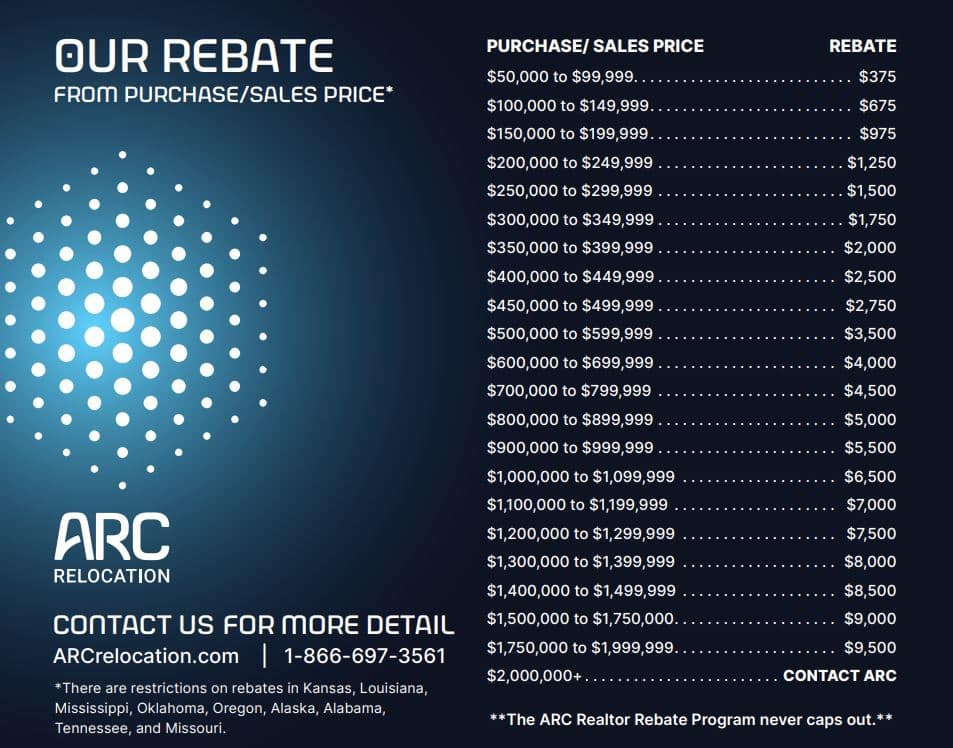
Benefits of the ARC Realtor Rebate Program
The ARC Realtor Rebate Program has many benefits when buying or selling your home.
- Opportunity to save a significant amount of money
- A minimum of 3 percent commission
- The cash rebate can be used for multiple purposes, such as moving expenses, furnishing your home, or reducing closing costs
- Offers an incentive for you to work with an experienced and participating real estate agent
- It can help expedite the sale of your home, as it may appear more attractive to buyers
How Do You Get a Rebate for Buying or Selling a Home?
To get a rebate for buying or selling a home, you must first follow a few steps to ensure you qualify. The first step is looking for a real estate agent that offers the rebate, such as an ARC real estate agent providing the ARC Realtor Rebate. Once you choose your real estate agent, you can buy or sell your home with the realtor’s guidance.
Once your transaction is completed, you will receive your cash rebate. The cash rebate is based on a certain percentage of your real estate agent’s commission. Your rebate amount can vary depending on the terms of the moving assistance program as well as the value of your transaction.
Fill out the form below to register today!
What Benefits Do Moving Assistance Programs Offer When Selling or Buying a Home?
There are various benefits of using a moving assistance program for help with moving costs throughout your relocation.
More Flexibility
Having more flexibility throughout your moving process is often one of the most favored benefits of using a moving assistance program. These types of relocation programs to help move out of state offer financial savings, which can help you have more flexibility and freedom in making decisions.
The flexibility can give you more options when choosing a better moving company, negotiating the price of your new home, making any necessary repairs, and having access to more money throughout the moving process.
The ARC Realtor Rebate program offers you the ability to choose your realtor. We have a large preferred network, click here to learn more!
Financial Savings
There are many costs associated with moving that can strain your finances. These costs include closing costs, moving fees, and unexpected expenses that often arise throughout the moving process. When you receive financial assistance with moving, you can get rebates to help offset these costs.
The cash rebate from the ARC Realtor Rebate program can help with relocating by reducing your closing costs, hiring professional movers, purchasing new furniture for your new home, or any other expenses needed to get you settled in your new home.
Power to Negotiate
Having negotiating power is ideal when you are involved in a real estate transaction. You can better negotiate using the ARC realtor Rebate program because of the cash rebate.
You can effectively negotiate with other real estate agents to reduce purchase prices, negotiate better terms, lower any fees associated with the move, and do anything you need to maximize the value of your transaction.
Strong Relationship With Your Real Estate Agent
When moving assistance programs offer rebates, you often develop a strong relationship with your real estate agent. Your realtor is committed to your fulfillment throughout the moving process. When working with a real estate agent who offers cash rebates when buying or selling a home, you can trust that your realtor will be loyal and trustworthy.
What Do Homebuyers Use Moving Assistance Rebates For?
Relocation assistance programs help with moving expenses and other factors associated with your move. These rebates can be used for the following:
Closing Costs
Closing costs are one of the most substantial costs of purchasing a home. A moving assistance rebate can help moving to another state become easier by covering a portion of your closing costs, which helps ease the financial burden of moving. Closing costs cover fees that come with buying or selling a home, such as appraisal fees and searches on the title of your home.
The specific closing costs can vary depending on the type of loan you have for your mortgage and where you live.
Making Repairs and Upgrades
You may need or want to make repairs or upgrades to your new home. Common home improvements include painting, flooring upgrades, remodeling a kitchen or bathroom, finishing a basement, and landscaping. Having extra funds from a rebate can help pay for necessary repairs or desired upgrades.
New Furniture
When moving to a new home, it is a typical expense to purchase new furniture and home decor. You can use the money from your moving assistance rebate to help buy these items for your new home.
The cost of new furniture can be costly, depending on if you are furnishing multiple rooms, or just one room, and how many home decor items you plan to buy. Typically, the cost of new furniture for a living room can range between $4,000 and $6,400, and new bedroom furniture can range between $2,500 and $6,000.
Future Maintenance and Emergencies
It is always smart to have money set aside for future home maintenance and repairs. Rebates allow you to create a fund to pay for regular home maintenance, such as appliance replacements, new roofs, HVAC repairs, plumbing issues, etc. This ensures you are prepared for common emergencies that come with home ownership.
Moving Costs
A rebate allows you to have financial help with moving costs, such as renting a moving truck, hiring a moving company to move to a new state, or purchasing supplies such as boxes, bubble wrap, tape, plastic bags, blankets, newspaper, or plastic storage bins. Moving costs can add up quickly, so having the extra money from your rebate is helpful to help cover some of these costs.
Emergency Funds
Having money set aside for emergencies is essential in case you need it. You may need access to the emergency funds if there are any unexpected costs throughout your move. It can be comforting to know that you have extra money for these emergencies if needed.
Moving Assistance – FAQs
How do I get moving assistance?
To get moving assistance, research and see which programs are available in your area. It is essential to pay attention to any eligibility requirements, such as your income or particular circumstances, but a rebate program often only requires you to be a homebuyer or seller.
What are the most common moving assistance programs?
Some of the most common moving assistance programs include the ARC Realtor Rebate Program, the Military Relocation Assistance Program, and the Community Heroes Rebate Program. These programs enable you to get a cash rebate for buying or selling a home but have different requirements.
How do moving assistance programs allow me to save money?
You can save money by using a moving assistance program, as you can earn back cash in rebates that allow you to have free money to relocate. The cash rebates allow you to have extra money to pay for moving expenses, such as hiring a moving company, renting a moving truck, purchasing new furniture for your home, or helping pay for your closing costs.
Who can qualify for a relocation assistance program?
Anyone buying or selling a home can qualify for the ARC Realtor Rebate program. For other relocation assistance programs, the qualifications differ.
For example, the Military Relocation Assistance Program requires you to be in the military to qualify. In contrast, the Community Heroes Rebate Program requires you to be a healthcare worker, teacher, emergency personnel, firefighter, law enforcement, or in the military.
How long does it take to receive my rebate?
You will typically receive your rebate within 30-60 days after closing on your home purchase or sale. The exact timing depends on the specific terms of the relocation assistance program. With the ARC Realtor Rebate, you can expect to receive your rebate shortly after completing all paperwork and finalizing the real estate transaction.
Final Thoughts
A moving assistance program can offer financial relief throughout your move, making you feel better prepared to buy or sell your home. In particular, the ARC Realtor Rebate Program gives you a cash rebate to help offset the costs associated with your move.
To start saving for your move today, contact a participating real estate agent and ask about the ARC Realtor Rebate Program.